

Oil and gas operators are increasingly willing to consider3D printing-Additive Manufacturing (AM) as a potential answer to its supply chain challenges to enable more efficient and cost-effective solutions to ongoing inventory and remote delivery barriers. Shell is the first company in Europe to receive CE certification from a third-party authority for in-house 3D printed parts.
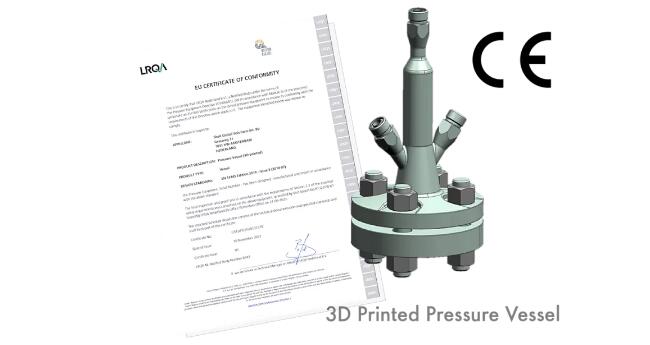
Recently, Shell and LRQA (formerly Lloyd’s Register) have approved a review of the European Pressure Equipment Directive (PED).3D printingPressure vessels are certified. The result of a 4-year collaboration, Shell was the first company in Europe to receive CE certification from a third-party authority in the energy sector for in-house 3D printed parts, with LRQA classifying 3D printed containers as PED III.
 © Shell
Xiao He only shows sharp corners
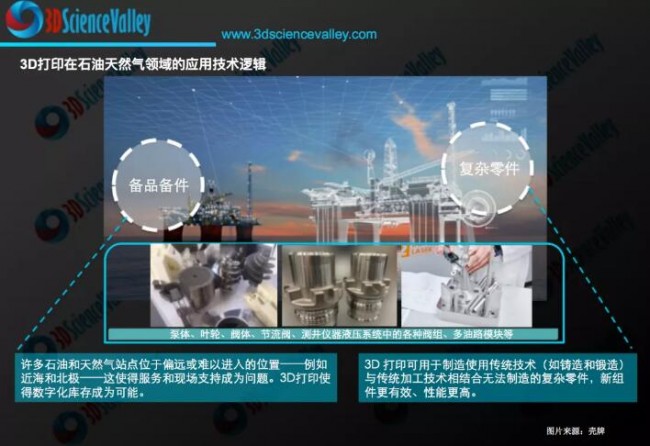
According to 3D Science Valley, major oil service industry giants have undergone digital transformation, and the certification has made 3D printing show a good trend of “small lotus only showing sharp corners” in the development trend of realizing digital inventory in the energy industry.
 © 3D Science Valley
 Milestone Certification
This represents an important milestone, not only for the additive manufacturing industry, but also for the pressure equipment community. This is the first CE marked pressure vessel approved by an independent Notified Body. The collaboration between Shell and LRQA is understood to be technically challenging but also highly rewarding. A pathway has now been established to certify additively manufactured pressure equipment according to PED.
 © Shell
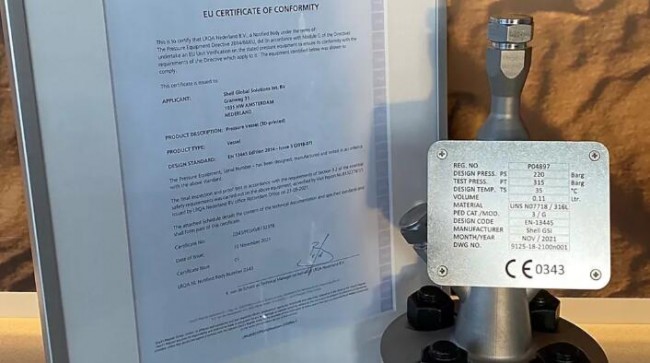
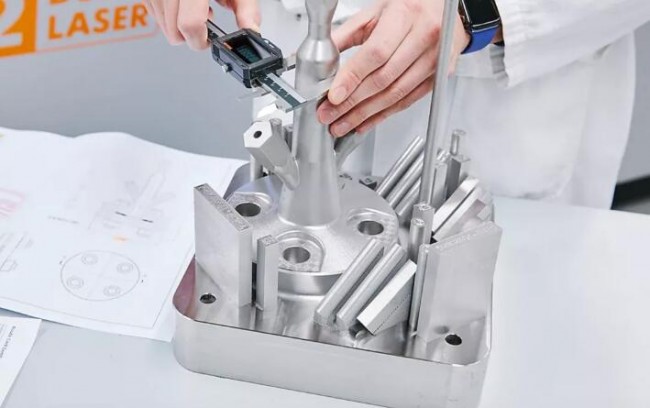
3D Science Valley understands that the vessel was manufactured on a powder bed melting additive manufacturing facility at Shell’s Energy Transition Park in Amsterdam and is designed for pressures up to 220 bar. The certification is an important milestone for the energy industry as, to date, there has been no legislation or global standard specifically for 3D printed pressure vessels, and the lack of regulations means that 3D printed pressure equipment is generally not allowed. Shell is collecting research data by 3D printing pressure vessels, which helps to increase the industry’s trust in additive manufacturing, which allows the inventory of pressure vessels to be digitized as a technical solution to procure spare parts “just in time”, Instead of stockpiling physical spare parts for years.
 © Shell
Create an ecosystem of digital inventory and manufacturing capabilities
Shell also runs several additive manufacturing projects for other parts together with relevant technical experts to gain knowledge for various applications of 3D printing, from spare parts management to rapid prototyping and testing of novel designs. Qualification work on pressure vessels provides valuable data points and insights to support discussions with standards bodies to expand the use of more additively manufactured parts. Shell will continue to be a leader in additive manufacturing R&D in the energy sector, working with multiple partners around the world to develop its capabilities and range of 3D printing applications in the energy sector. The knowledge Shell now has can also help its partners certify their 3D printed parts for commercialization.
Over the past few years, Shell has continued to increase its reliance on 3D printing and digital parts management through a number of global additive manufacturing projects in the energy sector.For example, Shell uses3D printing technologySignificantly reduced costs for offshore operations around Nigeria and partnered with energy company Baker Hughes to develop on-demand 3D printed impellers that could reduce lead times by up to 75%. Recently, Shell partnered with manufacturing services provider 3D Metalforge to supply 3D printed heat exchanger parts for one of its offshore facilities. The design of this heat exchanger part containing dedicated micro-ducts helps Shell minimize downtime of its equipment by reducing the likelihood of part failure.
While Shell’s in-house 3D printing capacity building began in 2011 with the use of metal laser printers to create unique test equipment, Shell today has around 15 plastic, ceramic and metal printers in its technology centers in Amsterdam and Bangalore.
Shell’s 3D printing strategy is not to manufacture the parts itself. Instead, the aim is to work with Shell’s technical authorities, OEMs and local partners to develop a digital warehouse that will store all the information needed to 3D print components when needed. A digital warehouse supported by a local ecosystem will truly reduce lead times, use resources more responsibly and bring progress to the local communities where Shell operates.
On the manufacturing site, using 3D printing services reduces the need to stock components. Teams only need to print the replacements needed, saving time and money. For example, at the Pernis refinery in the Netherlands, Shell is testing the use of 3D printing to produce an impeller for a production-critical 7-stage centrifugal pump, the first part of its kind in an additive-manufacturing application for a critical service multi-stage pump assembly.
The project was carried out in close collaboration with Baker Hughes – Baker Hughes, who will print the part. The pilot project – if successful – will mean that refineries can supply 3D printed pump impellers “just in time” rather than storing spare parts for years. It is estimated that 3D printing these production-critical components reduces supply time by 75% compared to using traditional manufacturing processes.
Baker Hughes – Baker Hughes Additive Manufacturing (AM) services leverage its global engineering expertise and resources to greatly expand the possibilities for material design and manufacturing, close delivery, and localized production development. Through AM-Additive Manufacturing technology, Baker Hughes customers can not only create more efficient and durable replacement parts, but also connect to an ecosystem that enables AM-Additive Manufacturing to industrialize and produce significantly lower operating costs and manufacturing lead time. In the digital manufacturing journey, Baker Hughes can digitally record and store CAD drawings of the entire inventory, enabling on-demand production of spare parts. As a result, the industry can reduce unnecessary overhead through a simplified supply chain. Another milestone was the successful 3D printing of an aluminum alloy impeller for a multi-stage high-pressure LNG pump by Shell and Elliott Group. This part is for low temperature hydrocarbon services, a new use case for the technology in the energy sector. The teams worked closely together to develop the technical specifications for the part and define the printing process. The actual printing, heat treatment and testing of the impeller was completed in 40 days, an 85% reduction in the normal lead time for producing such parts. In addition to this time reduction, the 3D printed impellers exhibited better mechanical properties compared to traditional cast impellers.
Overall, in collaboration with partners, Shell’s 3D printing strategy is paving the way for reducing the need to buy, hold and maintain a large inventory of spare parts, thereby reducing costs and waste. In addition, transport-related emissions can be reduced, and it also helps to create shorter, more efficient supply chains supported by local capabilities. 3D printing is becoming a mature manufacturing technology in other industries such as aerospace, automotive and medical, but the energy industry has been slow to develop. One of the main reasons is the lack of generally accepted technical standards in the industry. Solving this problem means that the whole supply chain Collaboration, from end user, assurance supplier to professional3D printing servicecompany and OEM.
(responsible editor: admin)
0 Comments for “A milestone in the oil and gas sector, Shell receives CE certification for 3D printed pressure vessels”