

On November 19, Autodesk announced the next step in its partnership with ANSYS, an industrial simulation software company. The two parties will establish seamless interoperability between design software and simulation software to revolutionize manufacturing users. design and engineering agility. In this collaboration, Autodesk’s 3D design software Fusion 360 will be linked with ANSYS Mechanical, a general-purpose structural mechanics simulation and analysis system, to shorten design cycles and accelerate product innovation.
 Breaking down the silos between design and simulation
This collaboration will break down the silos between designers and simulation analysts during product development, making them interoperable and establishing a design-simulation engineering process. Specifically, when design engineers use Fusion 360 for product modeling, the design results will automatically appear in ANSYS Mechanical for subsequent optimization and validation.

Autodesk Fusion 360
According to ANSYS, this open-system engineering process will significantly improve efficiency over existing manual processes and can be combined to enhance new automated processes such as generative design, which will reduce time-to-market and enable Multiple engineering teams can work together more smoothly.
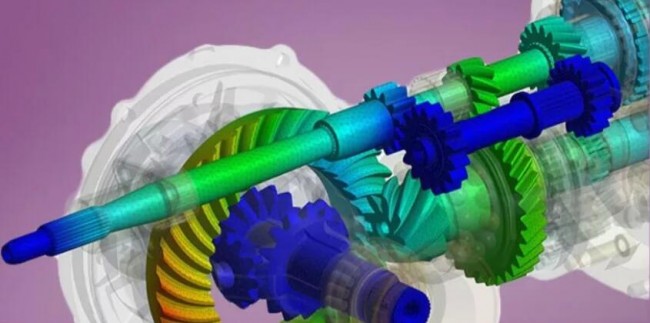
ANSYS Mechanical
Achieving product design vision and quality in product development is a collaborative effort between product design and simulation teams, but there are often silos between design and simulation, and the collaboration between Autodesk and ANSYS will enable the Improve the engineering process between design and simulation tools to collectively benefit manufacturing users. As designers and analysts benefit from this open, seamless process, manufacturers will improve new product development efficiency, cut costs, and accelerate product innovation and production.
Review
As Autodesk and ANSYS mentioned when they announced their cooperation, there are silos in the process of product design and development, and there are workflows that are difficult to connect between designers and analysts, and software giants such as Autodesk and ANSYS have seen it. The existing pain points are integrating resources in the ecosystem and working to create a more automated design workflow.
Autodesk is driving the convergence of not only 3D design software Fusion 360 with simulation, but also design and manufacturing. Fusion 360 software provides generative design capabilities, and the complex designs generated by generative design are particularly suitable for3D printingtechnology to manufacture, prior generative design often did not take into account the constraints of processing, although3D printingIt has inherent advantages in manufacturing complex designs, but many design results also require CNC machining to achieve higher precision and surface quality, which still lacks a certain degree of connection between design and manufacturability, and Fusion 360 innovation Ready-made design 2.5-axis version, connecting from the design side3D printingWith machining, the last mile linking design and manufacturing with additive manufacturing is being broken:3D printingA design compromise between technology and traditional manufacturing techniques.
Another software involved in this cooperation – ANSYS Mechanical is one of the core products of ANSYS. ANSYS Mechanical is a general structural mechanics simulation and analysis system, focusing on structural mechanics analysis, covering linear, nonlinear, static, dynamic, Fatigue, fracture, composites, optimization design, probabilistic design, thermal and thermal-structural coupling, piezoelectric analysis, and almost all functions. This simulation analysis system also plays a role in product design optimization for additive manufacturing.3D printingIn the simulation analysis of lattice structure, ANSYS Mechanical is used to perform mechanical analysis on the equivalent homogenized lattice.
Another design software giant, PTC, is also working on an integrated layout for design and manufacturing, integrating CAD software Cero with generative software and simulation technology. In 2018, PTC acquired Frustum Inc., a cloud-based generative design software company. PTC has a strategic partnership with ANSYS. The acquisition of Frustum complements the strategic relationship between the two parties, taking analysis upstream until the very beginning of the design process. stage. With the embedded capabilities of Frustum and ANSYS, Creo will be able to recommend design methods using generative design, guide users through the iterative design process using ANSYS Discovery Live, and ultimately validate complete product designs at scale using the broader ANSYS Discovery suite. By embedding these capabilities into Creo, engineers will be able to rapidly drive product innovation with unprecedented capabilities.
The integrated design and manufacturing layout of design software giants is taking shape, and such a layout, for the manufacturing industry, especially for those who are born with digital characteristics.3D printingIn terms of the combination with manufacturing, it can be said that it further presents a release3D printingPotential timing, geography, people and development potential.
(responsible editor: admin)
0 Comments for “Autodesk and ANSYS drive a seamless engineering process for 3D design and simulation, and product innovation will accelerate!”