

China3D printingNet, January 7th, Dubai hopes to carry out 25% of its new construction by 20253D printing.RussiaA recent report from the additive manufacturing company Apis Corp stated that it has built an office building in Dubai.Claims to be the largest in the world3D printingarchitecture. The company said the project broke the “Guinness Record.”
In the past, Apis Cor mistakenly thought that its first structure was printed within 24 hours, but in fact it was printed within four months. For this building, Apis Cor did clearly describe how long it took the printer to produce the building, but whether the building is “the largest in the world” remains to be determined by any official source.Regardless of whether the structure is actually the largest, the building is impressive, and according to the video clips, it appears that at least the walls of the first floor are actually on-site3D printing(We will enter the second layer) later). The two-story building uses Apis Cor’s portable additive manufacturing system for Dubai City printing. It is 9.5 meters (31 feet) high and has a building area of 640 square meters (6,900 square feet).
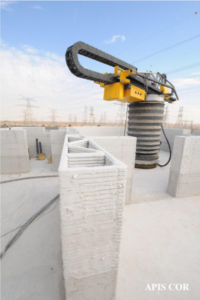
3D printing
The machine can expand its printing height” alt=” The hydraulic system makes Apis Cor
3D printing
The machine can extend its printing height” width=”200″ height=”300″ />
The hydraulic system makes Apis Cor 3D printingThe machine can expand its printing height. Image courtesy of Apis Cor.
Other additive manufacturing companies, such as WinSun, can understand the details of their projects, but in this case, Apis Cor has detailed what is printed and how it is printed.In the system3D printingBefore the wall, use prefabricated3D printingThe concrete slabs are used to lay the foundation, and then windows, ceilings and roofs are installed by traditional methods.Since Apis Cor’s prototype printer could only be done on a 3-meter-high wall before3D printingTherefore, the height of the boom must be increased, which unfortunately reduces the rigidity of the printer itself. To solve this problem, a hydraulic system was developed to lift the printer. The entire schedule of the project is limited to two months, which means that the Apis Cor team must create this setting on the construction site.
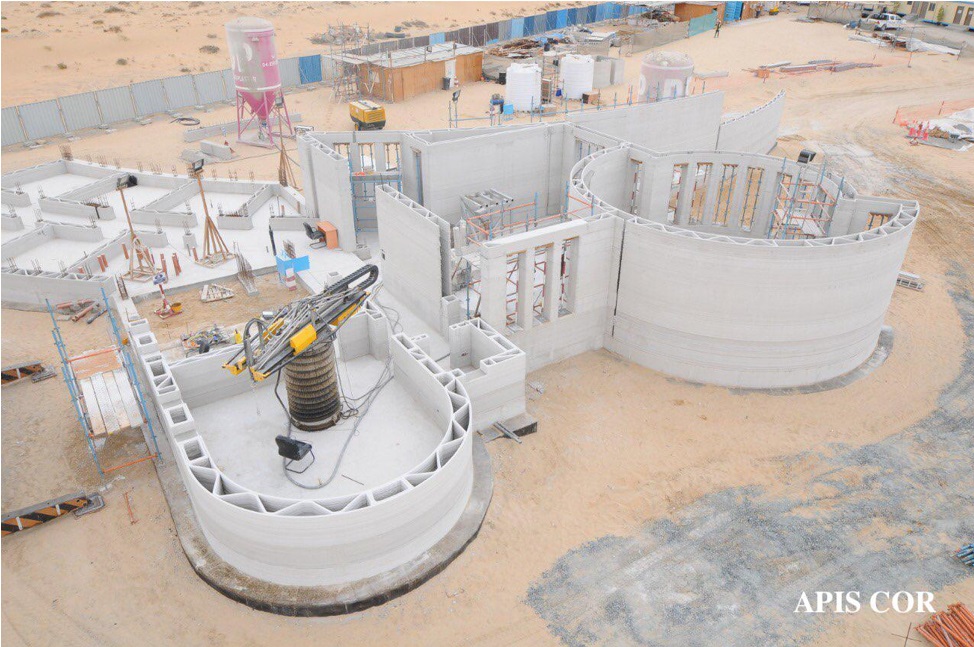
Due to the high temperatures in the Dubai desert, the temperature had reached 50°C (122°F) when the crew arrived in June 2019, so most buildings were printed at night. In addition, Apis Cor determined that it will need to develop a printing medium that takes into account the climate of the UAE and uses a gypsum mixture derived from local building materials as raw materials. The continuous fluctuation of climate temperature causes condensation on the printing equipment, which leads to the rust of metal parts. In order to solve this problem, Apis Cor used a specific lubricant on its guides and bearings, so that it decided to use stainless steel in future printer versions.
There are many manual interventions during the printing process, especially to bypass obstacles and install unprinted components. The company hopes to create a machine vision system to enable printers to avoid obstacles. Apis Cor conducts conformance tests before printing the walls and regularly inspects the equipment before each round of manufacturing.
According to the company, the total printing time is about 500 hours, eight hours a day, and the staff’s rest time may be as long as several days to several weeks because the general contractor integrates accessories, electronic equipment and the ceiling. After installing the ceiling on the first floor, take the printer to the second floor and start printing again. You will notice from the video that there is a jump from the time the printer starts printing the second layer to the completion of the project, which may cause people to doubt whether the system is used for the second layer. We can only see the print from one angle, so it may be important to maintain some healthy skepticism.According to Apis Cor, this building will be built3D printingThe first building in the entire area composed of structures. Printing was completed in August, and the entire project was completed in October.With other large3D printingUnlike buildings (such as those made by WinSun), this structure is not built using pre-printed walls, which are transported and assembled on site.The Russian company envisions the use of other automation technologies, which will further reduce human intervention and enable printers to produce ceilings, roofs and automatically install electrical components, doors and windows. The Apis Cor team also believes that multi-storey buildings are technically feasible, and the regulatory framework of additive construction is the main method of deployment.
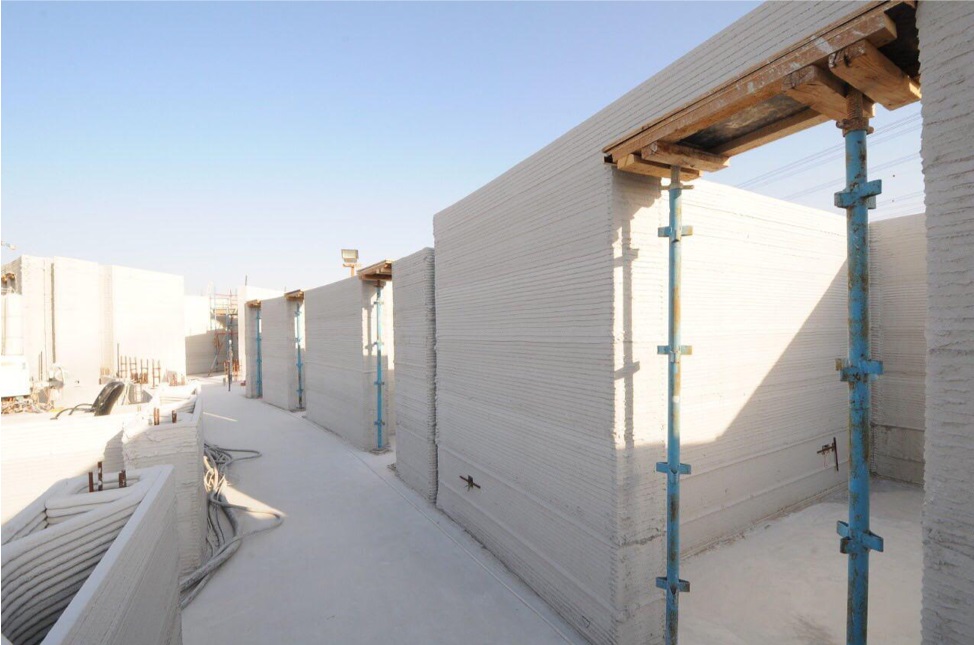
The company hopes to bypass obstacles to achieve an automatic printing process. Image courtesy of Apis Cor.
This new office building and the first building of Apis Cor3D printingThe buildings are far apart, and the latter is a small house built in Moscow as a model concept. This Russian company is unique in system design. It is a single arm that revolves around a platform instead of the standard gantry system of other concrete printers. As suggested by Apis Cor, such an architecture may be easier to transport.
China3D printingInternet comment: When we are not sure why Dubai will carry out 25% of its new construction by 20253D printingWhen, maybe3D printingThere are good reasons for construction, especially the reduction of labor and therefore the cost. This is important for a country like the United Arab Emirates, where 90% of the workforce is mainly from India, Bangladesh and Pakistan. Of the 9.2 million population, 7.8 million are migrant workers.Like automation in any industry, the use of machines to reduce labor costs can also be used to ignore labor demand.Therefore, for a city like Dubai3D printingA quarter of its buildings may still be bureaucratic in it.
(Editor in charge: admin)
0 Comments for “Dubai unveils “world’s largest” 3D printed building”