

The rake airflow probe is a component used in engine development that can obtain high-precision temperature and pressure readings to help engineers evaluate engine performance. The rake airflow probe installed directly on the engine airflow path must meet extremely high standards so that it can withstand extreme temperature, tensile and compressive loads. Therefore, the rake airflow probe is a highly complex component that must meet precise size requirements and have a smooth aerodynamic surface to achieve accurate measurement.
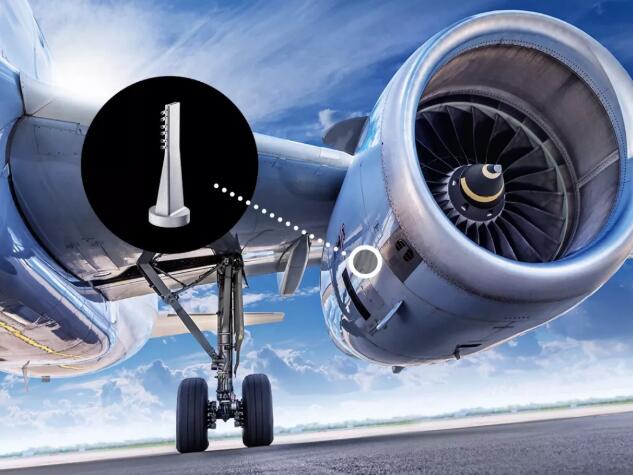
The specific location of the rake airflow probe, source: TRUMPF
Four carefully polished components are assembled by hand and individually welded to form a rake airflow probe. At its core, there are several inner tubes used as channels, with a wall thickness of less than 0.3 mm. These channels need to be inserted into the rear of the slender body of the rake airflow probe and welded in place on the Kiel head. Then seal the main body of the rake airflow probe with a cover plate. “Those delicate channels must be inserted with the highest precision,” explains López-Vidal (R&D manager of Ramen). “As long as one Kiel head is incorrectly welded, the entire rake airflow probe will be scrapped. The Kiel head has a dimensional tolerance of +/-0.05 mm, has a narrow continuous opening, and an integrated flow sensor at the end.”
The Ramen engineers discovered that additive manufacturing is the ideal method of manufacturing precision rake airflow probes. The challenge in achieving this task is to design a way that is compatible with additive manufacturing. However, the rake airflow probe was deformed in the early production, and the printing process was not smooth. Powder and other solids were deposited in the narrow passage. In addition, the additive manufacturing process cannot meet various requirements such as dimensional accuracy, smoothness, and non-porous rake surfaces.
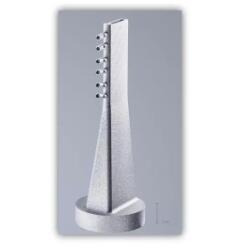
Additively manufactured rake airflow probe, source: TRUMPF
By chance, López-Vidal and his team visited the TRUMPF booth at the 2017 Frankfurt International Precision Molding Exhibition (Formnext) and discussed the problems they faced with the TRUMPF team. The TRUMPF team began to find an effective solution. The most challenging part of the printing process is the orientation of the parts. Since these parts cannot be connected to the vulnerable Kiel head or any position within the part, the parts must be aligned so that printing can be done without a supporting structure. The risk of thermal deformation must also be eliminated. This is not easy because the rake airflow probe is very thin and has a large upper part. This time, TruPrint 1000 was used for printing and manufacturing. The molding space of the machine is about 100 mm x 100 mm, with a 200 W laser, which is suitable for additive manufacturing of precision structures. This machine successfully produced the first prototype that met all the requirements. The 3D scan proved that the prototype had the required geometric accuracy; at the same time, a density of 99.95% was determined through micrographs.
But the experts were eager for more accurate information, so they sent the prototype to Yxlon, a developer and manufacturer of X-ray and computed tomography inspection systems, for CT scans. Yxlon verifies the continuity of the channel and the size of the hole. The TRUMPF experts also determined and checked more than 40 measured values inside the components. The measurement results show that the component has a clear channel, meets the required dimensional accuracy, and the aperture is less than 100 μm. Because the redesign of the components has shortened the production time, and the amount of materials used has been reduced by about 80%. In short, by 3D printing the rake airflow probe, the overall cost has been reduced by approximately 74%. In this industry, this is a number that affects the overall situation.
López-Vidal also firmly believes that this part manufacturing process marks that additive manufacturing will be able to provide more practical solutions for the aerospace industry. The rake airflow probe is just a small epitome of the application of additive manufacturing. The key is to actively adopt new methods to let decision makers know the new opportunities brought by additive manufacturing in a timely manner.
(Editor in charge: admin)
0 Comments for “Metal 3D printing technology helps reduce the overall cost of aero engine rake airflow probes by 74%”