

China3D printingNet January 14th, LEMurr is a researcher at the University of Texas at El Paso.3D printingMedical equipment is outlined and published in the recently published “Metallurgical Principles Applied to Powder Bed Fusion3D printing/Individualized and optimized metal and alloy biomedical additive manufacturingImplantsGave an overview.
Powder bed fusion technology that uses both SLM and EBM technologies continues to be popular around the world, including in hospitals, which use commercial systems to create patient-specific medical equipment.
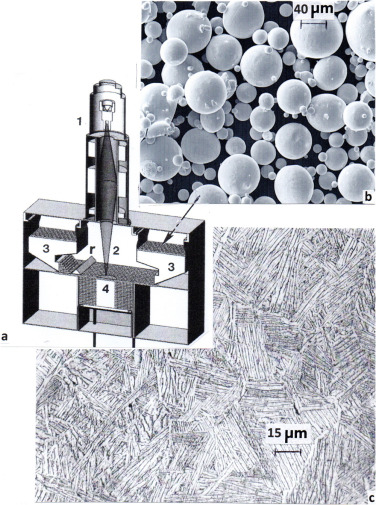
The EBM system used in the manufacture of Ti-6Al-4 V products (Figure 1c). (A) Schematic diagram of EBM, showing an electron gun operating at a voltage of 60 kV under (1) voltage, scanning the focused electron beam through CAD (2) to selectively melt the tilted (r) from the carton (3)3D printingThe powder layer gravity of product (4). (B) As shown in (a), put Ti-6Al-4 V powder in the EBM box. (C) Optical micrograph showing the microstructure of Ti-6Al-4 V EBM solid, α phase, lenticular crystal grains.
“The main difference between the metal or alloy products made by EBM and SLM is the lower SLM powder bed temperature and faster cooling or cooling rate,” Murr explained. “This will cause internal strain in some SLM products, and these products usually require hot isostatic pressing (HIPing) to reduce this inherent strain, and will cause product warpage or other deformation. SLM product surface is usually more Smooth, for some applications, this may be an important feature.”
although3D printing, The challenges of additive manufacturing processes and material selection continue, but researchers around the world are still constantly innovating implants, whether for the brain, teeth, spine or more implants, in many cases ( Even in some cases) can improve the quality of life. Murr pointed out that many attempts have been made to produce functional and effective porous materials. Medical device manufacturers have been working hard to create new ways to produce implants with suitable porosity.
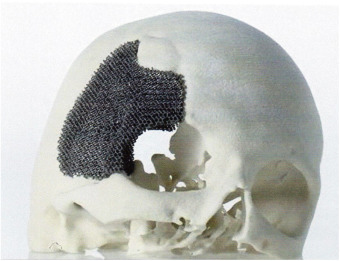
Ti-6Al-4 V rhombic dodecahedron mesh skull insert manufactured by EBM, used for patient-specific CAD-generated polymer skull models.
“As of 2019, there are hundreds of so-called immediate medical3D printingCenter or hubMurrSaid: “Some people are in the plastic surgery department, while others provide services to various surgical departments, including developing3D printingSurgical planning model. “
Nowadays, most of those responsible for manufacturing implants3D printingBoth medical centers and service laboratories use Ti-6Al-4 V powder:
.
Maxillofacial reconstruction
.Skull
.Spine Inserts
.Total hip and knee implants
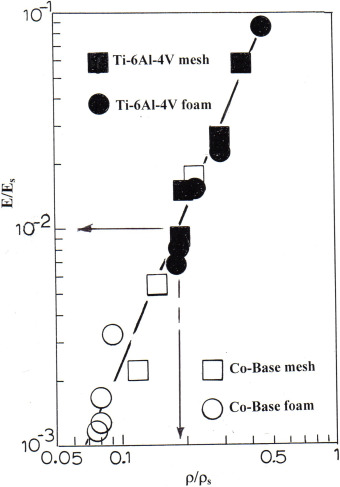
The relationship between the relative elastic modulus (E / Es) and relative density (ρ/ρs) of Ti-6Al-4 V grids and foams and Co-Cr-Mo alloy grids and foam samples manufactured by EBM. Adapted from Murr [9]. Note that the arrow along the fitted line corresponds to E / Es = 0.02 and ρ/ρs = 0.18, and its slope corresponds to the exponent 2 in Eq. (11).
“In the past 20 years, although a lot of titanium alloy system development research has been carried out, including alloys such as Ti-24Nb-4Zr-7.9 Sn, the Young’s modulus is less than half of Ti-6Al. -4 V, there is almost no incentive to use these alloys for implant manufacturing, whether it is biomedical or economical,” the researchers concluded.
“For Ti-6Al-4 V, the main microstructure is composed of various α phase sizes or αʹ- (martensite) phase sizes, and the hardness (Vickers hardness) can be adjusted in the range of about 3.5-4.5 GPa as strength And the corresponding manipulation of ductility. Although this can ensure that the porous, open cell implant design is highly biomechanically compatible with the bone, the optimal bone ingrowth can not only ensure the effective fixation of the implant, but also Make the implant a bone scaffold or an ideal bone substitute.”
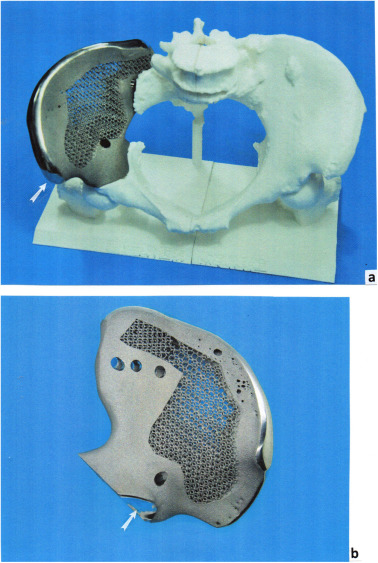
The Ti-6Al-4 V porous mesh pelvic belt manufactured by EBM is customized for patient-specific polymer T-CAD models (a). (B) Shows the inverted titanium alloy pelvic insert with arrows, indicating the attachment of the acetabular prosthesis to the right leg.
China3D printingNet original article!
(Editor in charge: admin)
0 Comments for “Overview: Fusion powder bed for 3D printed biomedical implants”