

China3D printingOn December 28th, oral cancer is on the rise globally. In developing countries such as Pakistan, Sri Lanka and India, oral cancer is a particularly serious disease because these countries do not have the necessary medical infrastructure for early detection and treat.Even with surgery, the high cost of radiotherapy and chemotherapy treatment and logistical obstacles often lead to the development of difficult-to-control high-morbidity advanced disease. Even in the case of cure, these methods can cause serious side effects in terms of beauty and function.A group of researchers from Boston and India explained in their paper: “Using low-cost, modular3D printingThe components are a platform for ergonomic intraoral photodynamic therapy.
Another effective treatment for oral cancer is light-based spatially targeted cytotoxic therapy called photodynamic therapy (PDT). “
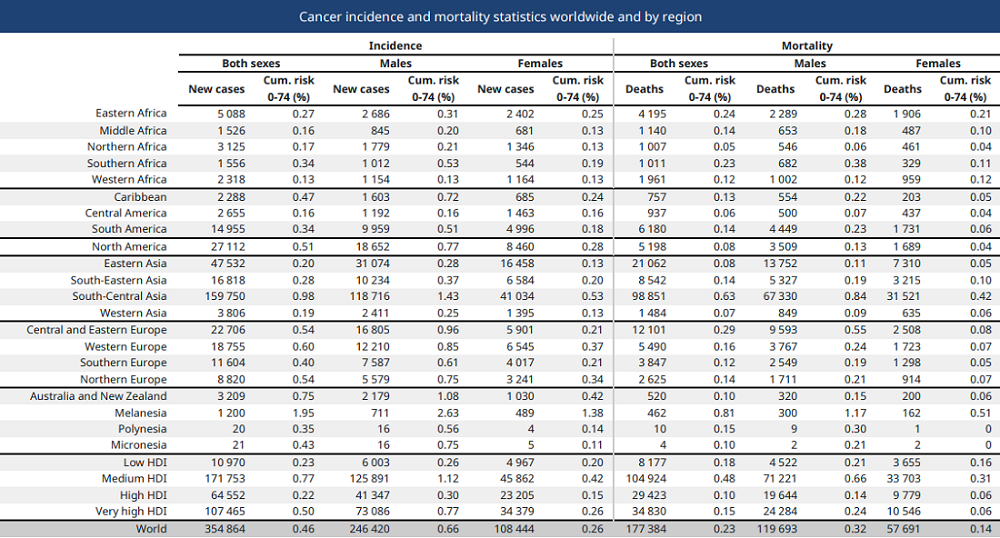
(Global Cancer Observatory)
PDT uses photosensitizer molecules that accumulate in tumors. Once it interacts with a specific wavelength of light, it can cause targeted damage. It has almost no side effects, does not cause disfigurement or loss of sensation, and has shown good clinical effects in healing and epithelial necrosis after good treatment.For areas with less medical resources, PDT therapy is very helpful, so it can be seen in the outpatient clinic, and3D printingThe oral applicator will provide a huge help in this process.According to China3D printingNetwork understanding,
Although PDT can heal the oral mucosa well, the lack of reliable intraoral light transmission technology limits its wide application.
use3D printingWith the advancement of technology, researchers have developed an intraoral optical transmission system, which is composed of modular3D printingThe light applicator is composed of a pre-calibrated dosimetry and oral stent that can be used to perform PDT in conscious subjects without extensive infrastructure or manual fiber placement.
The goal of the research team is to evaluate its3D printingThe clinical practicality and ergonomics of oral PDT applicators, these applicators are designed to comfortably and stably provide light to patients’ oral lesions.The researchers explained: “Here, the natural structure of the patient’s mouth, teeth, and jaw provides support and stability for fixing the fiber in place, avoiding any use of posts, brackets, reflectors or light pipes.”
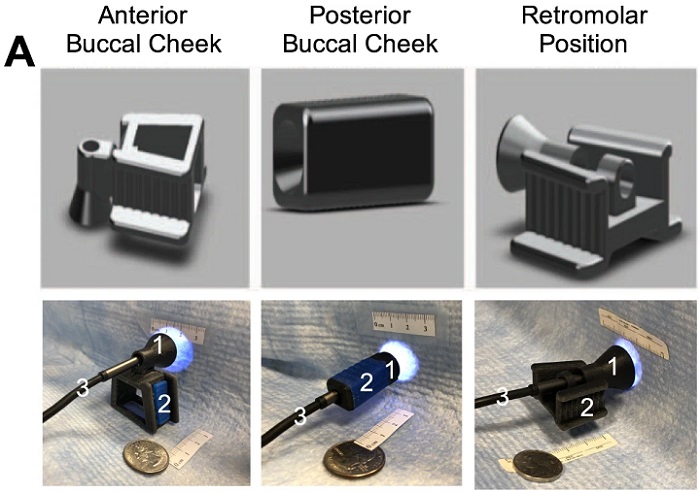
3D schematics of the applicator in three different areas of the mouth. These photos show the integrated unit with applicator (1), bite wing (2) and endoscope (3) used in ergonomic clinical research.
Connected to fiber3D printingThe intraoral applicator is divided into two parts-bite and applicator. These blocks position the angle of the applicator and then deliver the appropriate beam spot and pre-calibrated dosimetry to a specific lesion size. The team used Autodesk Fusion 360 to design the luminaire and printed it on the Stratasys Objet Pro system using VeroBlue and VeroBlack filaments.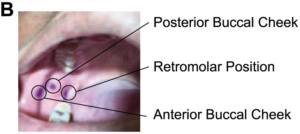
Three-point oral photos with ink traces tested in the ergonomics study.
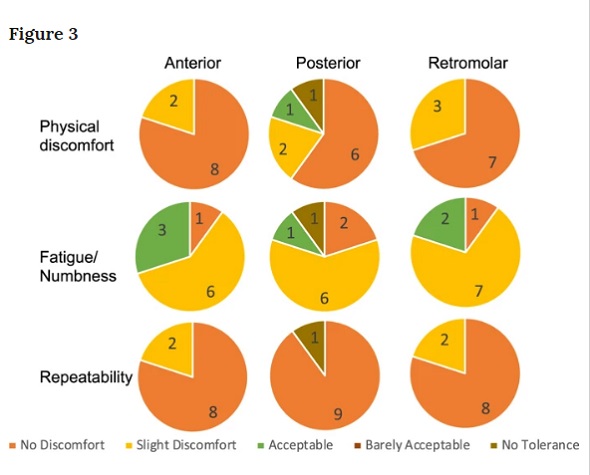
To determine the stability and comfort of the applicator, the researchers conducted a study on ten subjects, which was approved by the Massachusetts General Hospital’s partner institution review board.A doctor placed three reference ink marks on the inner cheeks of each subject and tested the front and back cheek and posterior molar positions for ten minutes, one by one. In order to record the movement of these three points, a similar-sized endoscope, a 5.5mm diameter camera and 6 LEDs were used to replace the optical fiber.The researchers explained: “The subjects were asked to rate comfort and fatigue on a scale of 1 to 5. One of them did not feel discomfort due to the applicator, and 5 did not cause discomfort due to the applicator. .”
Three questions were asked for each topic:
Did you feel sick within ten minutes?
Feel tired or numb to your mouth.
Would you like to repeat another ten-minute interval at the same site immediately?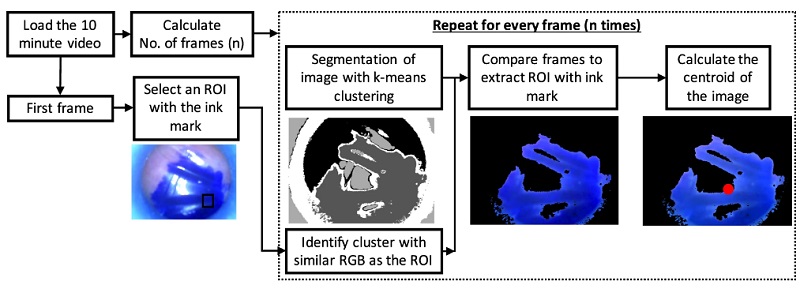
A flowchart of the video and image processing method used to calculate the centroid of the reference ink mark of the simulated anterior cheek, posterior cheek or posterior molar position of the cheek, which is imaged by the USB endoscope mounted on the oral applicator.
In addition, the endoscope actually records the movement of the ink during the test to assess the stability of the applicator. Use custom design algorithms in MATLAB to process the video. They determined that the applicator was indeed stable and was able to “precisely deliver the light of ten healthy volunteers to the target location.” In addition, the overall evaluation of the device by ten subjects was comfortable, although one of them did report to the applicator. “No tolerance”. The position behind the cheek.Five of the subjects had confirmed T1N0M0 oral cancer lesions without lymph node involvement, and several months after PDT treatment, they showed no cancer lesions, fibrosis or scarring.This shows that3D printingThe applicator used in conjunction with inexpensive optical fibers and LED-based light sources, “can be used as a complete platform for intraoral light transmission, and in the initial histopathological follow-up of these patients, a complete tumor response and no residual disease can be achieved.Although we use a set of applicators of predetermined sizes that can be adapted to various subjects, the size and gender of the mouth and jaws, it is conceivable to extend this method to customized patient treatments.Specifically, due to image-based3D printingAdvances in technology and low-cost, high-quality in the clinical environment3D printingThe usability of the machine continues to improve, and the personalized applicator can be quickly printed out during surgery. “
China3D printingNet Comments: The ergonomic design of the 3D printable light applicator has significant practical benefits in terms of achieving longer exposure time and improving the light transmission accuracy required for curative PDT. With the increase in health care and cancer incidence worldwide, especially in developing countries, this provides us with an affordable method that can provide stable and ergonomic light in the oral cavity. Use LED-based light sources with low-cost, portable, battery-powered fiber-optic coupling.this is only3D printingAnother good example of successful use in cancer treatment. We should see more cases in this area in the future!
(Editor in charge: admin)
0 Comments for “Researchers evaluate the comfort and stability of 3D printing technology in the treatment of oral cancer”