

China3D printingNet January 9th, researchers from Northwestern University and Chicago’s Ann Robert H. Lurie Children’s Hospital published a paper detailing the use ofbiology3D printingContinued development of ovarian ink.
This ink is filled with structural proteins derived from porcine ovaries. The locations of these proteins have been mapped and identified in research.
With this ink, you can3D printingArtificial ovaries are implanted in infertile women and they are then allowed to give birth to children. Ann & Robert H. Lurie Fertility and Hormone Preservation and Recovery Program Fundamental and Translational Research Director Dr. Monica Laronda commented: “For girls undergoing fertility-destroying cancer treatment, this is a big step forward.” Chicago An assistant professor of pediatrics at Northwestern University Feinberg School of Medicine at Children’s Hospital commented:
“Our goal is to use ovarian structural proteins to build a biological scaffold that can support a bunch of potential eggs and hormone-producing cells. Once implanted, the artificial ovary will respond to natural ovulation cues, making pregnancy smoother.”
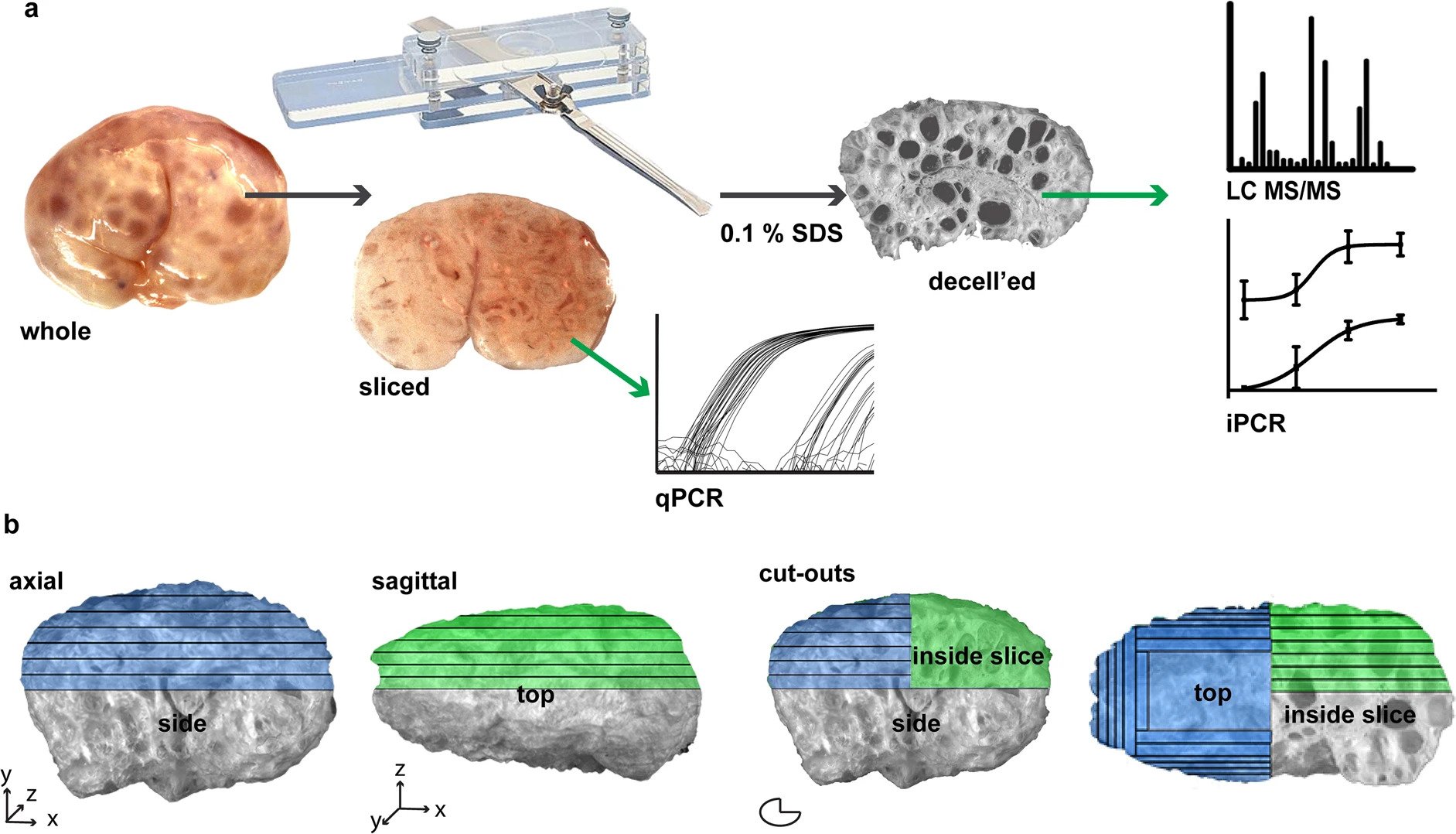
Schematic diagram of processing porcine ovaries with a tissue slicer.
3D printingFunctional ovary
Ann & Robert H. Lurie Children’s Hospital is a national pediatric specialist hospital located in Chicago. The hospital’s research results are carried out through the Stanley Mann Children’s Institute, which focuses on “improving children’s health, changing pediatric medicine, and ensuring a healthier future.
In 2016, one of the authors of this new study, Dr. Laronda (Laronda) revealed that his research team3D printingAnd the details of the research work that successfully implanted functional biological sense ovaries into female mice.This is usingbiology3D printingThe stent is completed with follicles, which are made of biogel derived from animal protein collagen.
In 2017, the details of the research were published in Nature Communications.Mice are able to ovulate and lay down with3D printingHealthy bedding for the organ, which replaces the original ovary of the mouse. The main purpose of this research project is to prove women who cannot restore fertility and hormone production after cancer or other developmental problems.

3D printing
Mouse ovarian cell scaffold” alt=”
3D printing
The mouse ovary cell scaffold” width=”620″ height=”497″ />
3D printingScaffold of mouse ovarian cells. The picture comes from Northwestern University.
Towards3D printingBio-ink for human ovaries
Dr. Laronda and three other colleagues obtained a patent for creating artificial ovaries in November 2019. In this new study, the researchers mapped the composition of the porcine ovary, which provided a channel for determining the location of its structural proteins. Dr. Laronda added: “The structural protein from pig ovaries is the same type of protein found in humans, providing us with a rich source of more complex bio-inks that can be used for3D printingHuman ovary. We are one step closer to regaining fertility and hormone production in young women who survived childhood cancer but entered late menopause. We are happy to test our new ink. “
The research paper also explains that the methods used to map structural proteins can also be applied by scientists studying other human organs.Northwestern University continues to maintain3D printingTechnology-related research results. The university recently detailed a new type of large-scale SLA 3D printingMachine, the printer can print half a yard (457.2 mm) within an hour, which is reportedly3D printingRecord throughput.In addition, researchers at this academic institution also use3D printingThe super-elastic bone is used to regenerate the skull defect in rats, which may lead to the development of a cost-effective solution for craniofacial bone grafting.
China3D printingNet original article!
(Editor in charge: admin)
0 Comments for “Researchers have made progress in 3D printing functional human ovarian bio-ink”