

China3D printingNet October 25th,
Complete3D printingThe battery, composed of flexible cellulose and glycerol substrates and patterned with conductive carbon and graphite inks, is capable of withstanding thousands of charge cycles while maintaining its capacity. Thanks to its biodegradable base, the new battery can also be composted when completed, potentially making it an ideal tool for tackling the world’s e-waste problem.
In search of a sustainable “EDLC”
The recent boom in electronic wearables, packaging and Internet of Things (IoT) applications has increased the global number of these devices to 27 billion, according to EMPA scientists. However, given their short life cycles and the fact that they are often powered by non-renewable lithium-ion or alkaline batteries, many of these products end up in landfills, exacerbating the global “e-waste” problem.
To develop more environmentally friendly energy storage devices, scientists have therefore begun experimenting with electric double-layer capacitors, or “EDLCs.” These high-capacity, fast-charging supercapacitors can be made at least in part from biodegradable materials, potentially making them ideal replacements for common batteries that often require specialized handling services.
Despite extensive research into EDLC R&D, their different components, such as electrodes and current collectors, can be difficult to produce through a single manufacturing process. What’s more, many prototype EDLCs are at best partially 3D printed, requiring time-consuming and expensive assembly or post-processing, making them unattractive as commercial ventures.
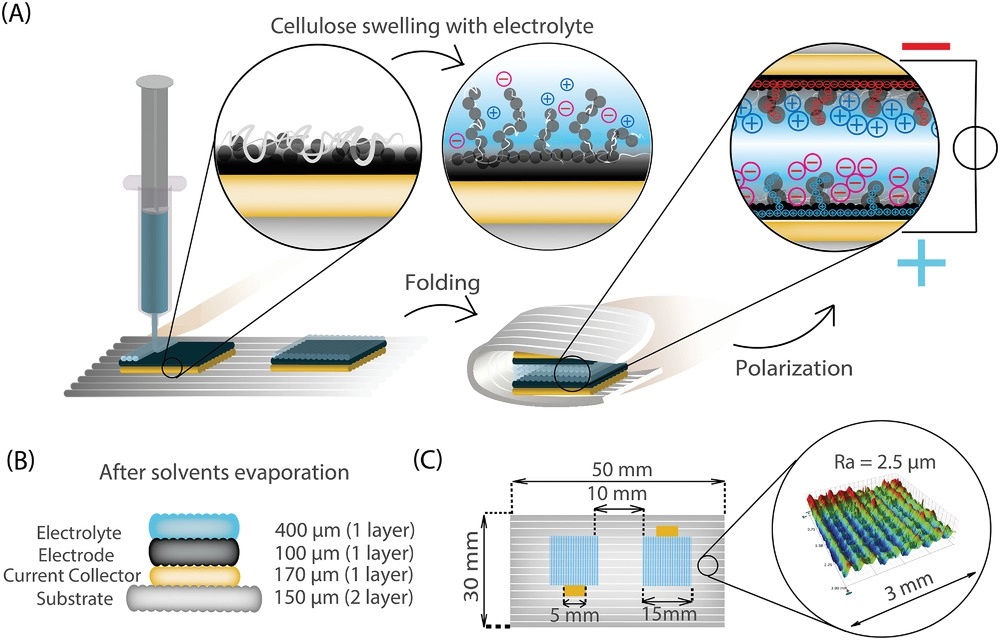
EMPA researchers’ battery DIW 3D printing method. Image via Advanced Materials magazine.
“State-of-the-art” supercapacitors
To simplify EDLC production and create their own eco-friendly batteries, the EMPA team turned to DIW 3D printing, which they used to create two half-cells, which were then folded together. In practice, this means printing the cell’s substrate first, then depositing its electrodes and conductive graphite-infused electrolyte layer on top, with some tweaking in the process, resulting in a functional battery.
“It sounds simple, but it’s not,” says Xavier Aeby of EMPA’s Cellulose and Wood Materials Laboratory. “It goes through a series of extended tests until all parameters are correct, until all components are reliably flowing out of the printer and the capacitors are working.” He added: “As researchers, we don’t want to just fiddle, we also want to understand our What’s going on inside the material.”
Once their supercapacitor prototype was ready, the scientists attempted to test its charge retention ability by charging it to 0.5 V before measuring its open-surface voltage. According to the researchers, their device still had 30 percent charge remaining after 150 hours, putting its performance “on par with that of state-of-the-art carbon-based supercapacitors.”
Interestingly, the researchers found that the capacity of their supercapacitors also fluctuated two weeks after fabrication, then stabilized, while remaining functional after eight months of storage. When they finished their experiments and tried composting, they were able to dissolve in Over the course of nine weeks, it was about 50 percent of its mass.
During testing, the team’s device was eventually able to power a 3V alarm clock under mechanical stress and operate at widely varying temperatures. As such, they say, with further R&D, it could be deployed on a wider scale to sustainably power low-voltage smart devices, such as those used in environmental monitoring, e-textiles or healthcare applications.
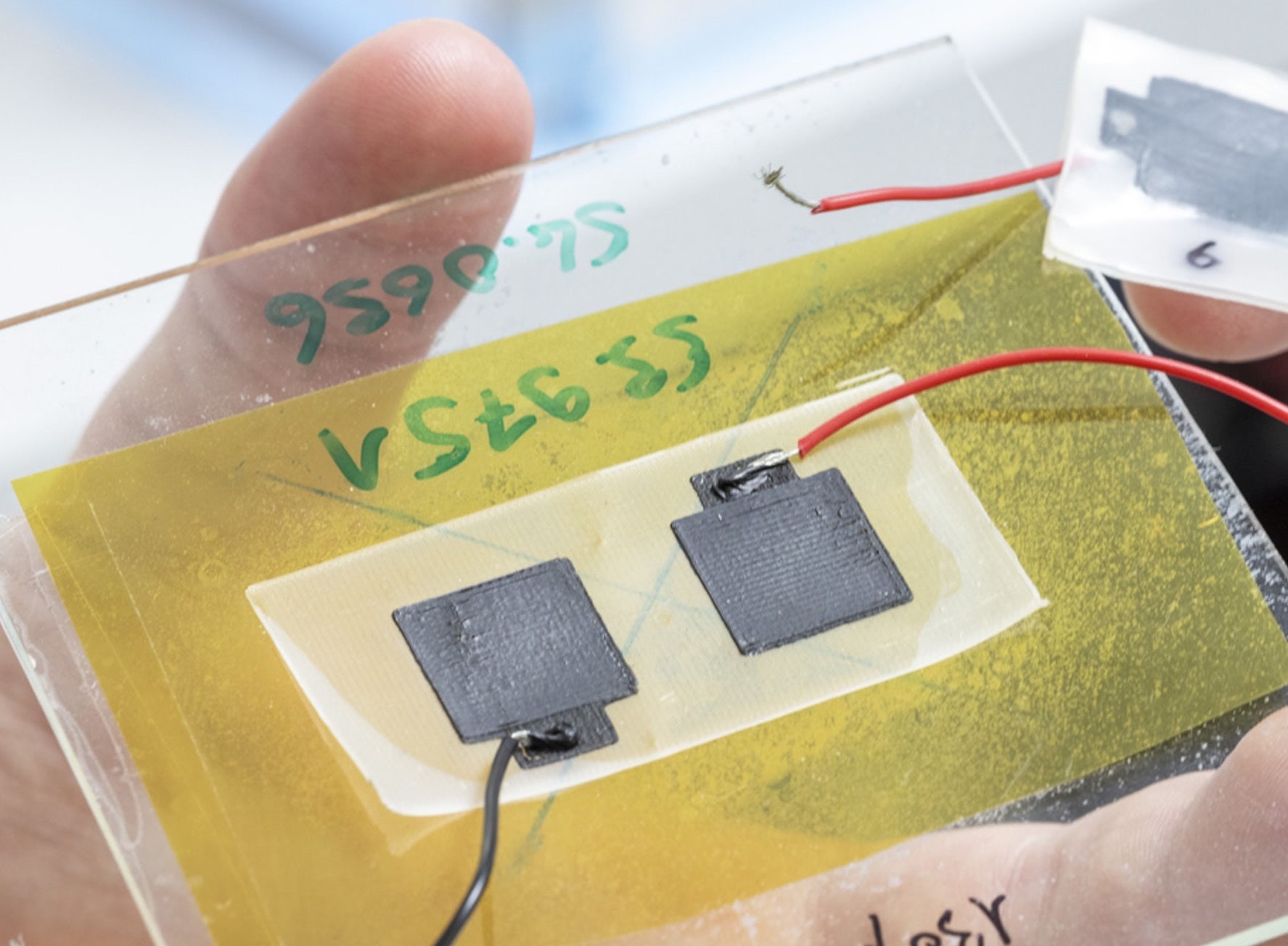
The researchers believe that their 3D printed supercapacitors have the potential to power other low-voltage devices in the future. Photo via EMPA.
Printed Batteries: Ready to go to market?
While 3D printed batteries are still in a relatively early stage of development, there are signs that the technology is moving towards end use. The rebranded Sakuu Corporation, formerly known as KeraCel, recently announced plans to launch its first solid-state battery (SSB) 3D printer in 2022, which it says will produce batteries with a much higher capacity than current lithium-ion devices.
In the UK, 3D printer manufacturer Photocentric, which has set up an in-house battery research and development department, is trying to design a new energy-efficient storage device of its own. By reducing the size and weight of the battery electrodes, the company’s ultimate goal is to develop a device that’s more suitable for automotive applications, and it’s said to be targeting the upcoming Tesla Giga factory.
In a similar but more experimental study, a team from the University of Manchester developed a 3D printable “MXene” ink and used it to produce prototype supercapacitors. During tests, the scientists said their additively manufactured electrodes demonstrated the high capacitance and energy density needed to power future cars or cell phones.
China3D printingNet compiled articles!
(responsible editor: admin)
0 Comments for “Scientists 3D print biodegradable batteries to reduce e-waste”