

No matter how technology changes, or how dazzling new innovations are, the basic goals of manufacturing remain the same: reduce unplanned downtime, reduce costs, eliminate unnecessary waste, and so on.along with3D printingWith advances in technology and materials, some existing suppliers are creating expertise in the field of additive manufacturing in order to control their supply chains and change the way they deliver products to customers.3D printingIt is deeply affecting the supply chain and business model, and will create exponentially growing business opportunities.Correspondingly, the manufacturing ecosystem is changing rapidly due to3D printingThe ability of technology to grow continuously.
Spreading the fire of additive thinking, this issue of SparkTALK, is sponsored by SparkUnion-a member of Spark Union-HP3D printingTalk to Mr. Zhao Hua, the person in charge of the digital manufacturing business in Southern China, about his contribution to the traditional manufacturing supply chain3D printingIn-depth thinking about opportunities and challenges in order to help companies thrive in a dynamically changing ecosystem and gain the ability to create added value in the manufacturing industry.
“The client will contact us at seven o’clock in the evening to confirm the design, starting at eight o’clock3D printingProcessed to 12 o’clock, sent across the city at 1 o’clock in the morning, and arrived in the hands of users thousands of miles away at 8 o’clock in the morning.” A recent article regained attention to the stories that happened in the manufacturing capital every day, and amazed countless people. It injects pride into the argument that China is inseparable from the manufacturing industry. At the same time, a problem that this kind of phenomenon raises is deliberately or unintentionally ignored: With such fast engineering prototyping and manufacturing response services, how big are Chinese technology companies? To a certain extent, benefit from the enhancement of core technology pre-research and high value-added product development capabilities.
3D printingThe changes brought about by the supply chain are intuitive: on the one hand, we can boldly use this round of global design to get rid of the shackles and re-change wave, and hope that more original products in more industries will expand upstream of the value chain; on the other hand, , On the basis of the original, we can also safely3D printingStereotypes are a rapid replacement of traditional production and processing methods, and continue to focus on the ultimate advantages of supply chain cost and efficiency.

 3D printingAnd digital manufacturing bring irreversible changes in the value chain and supply chain on a global scale
In the field of engineering technology, the vast majority of product development has to go through the process from market research, product definition, prototype design and verification, trial production to mass manufacturing, post-marketing service maintenance until it is gradually replaced by new products. Call it the product life cycle. This cycle appears in different industries and different markets, and the time span is several months, or several years or even longer. In this process, the core competitiveness and profits of OEMs are often concentrated in certain specific areas of expertise, which are called the key to the value chain.
With the division of labor in the global manufacturing industry in the past few decades, more and more companies have separated the marketing/R&D design and production assembly/purchasing logistics links, and the latter has formed a CM and multiple A complete cross-industry supply chain system represented by level suppliers. This kind of manufacturing process is efficient, but after the PK of production efficiency has reached an unparalleled degree of lean, it has prompted OEM companies to invest more in marketing and technology research and development in order to tap the core value of non-production links and distinguish them from competitors.
3D printing, Especially industrial3D printingThe technological breakthroughs and demand explosions in the past three years have largely responded to this demand: to provide more rapid innovation, personalized customization possibilities for end-user products, and to bring enterprises (OEM) Re-liberate the basis for designing and transformatively improving product performance.
The design of the front-end enterprise adopts3D printingAfter bringing a new generation of products, this in turn requires the back-end production and manufacturing links to accelerate the pace of adopting 3D technology to meet mass production needs. It should be noted that we are often easy to underestimate the cumulative impact on various industries due to basic technological breakthroughs and the active adoption of pioneers, until it becomes an industry consensus and becomes an irreversible situation.
Complete traditional supply chain foundation-for3D printingThe challenge of application acceptance
If a worker wants to do his job well, he must first sharpen his tools.It is precisely because of the insight into manufacturing trends that in the past few years, most countries have adopted3D printingListed as a basic discipline with digital manufacturing, it is used as an important tool to promote technological progress in all walks of life. However, affected by the initial factors and comparative advantages, the actual adoption and application paths have slowly shown clear differences:
In countries represented by Germany and Japan, traditional manufacturing Tier 1 suppliers or solution integrators have become3D printingAn important force to boost. This is largely due to the fact that most of the manufacturing itself is carried out in other countries. Over the years of accumulation, local suppliers/service providers have been deeply integrated with enterprise customers (OEM) in upstream research, design and verification to obtain additional The sharing of valuable profits has become an important force in the forward-looking application of new technologies. In the US engineering and technology industry, companies will often set up new edge innovation departments within the company to be independent of the traditional decision-making process and conduct more flexible R&D explorations to promote the development of new technologies to new products.
Although these situations are slightly different, what these countries have in common is that since manufacturing, assembly and supply chains are not carried out in their own countries, it is easy to build consensus when adopting new technologies.will3D printingThe breakthrough point is to choose the design performance improvement that the technology itself can bring to maximize the long-term competitiveness of the enterprise in the market. On the contrary, my country, as the world’s largest market for manufacturing, as the only country in the world that has all the industrial categories in the United Nations Industrial Classification, has the world’s most complete multi-level supply chain system, and has gradually formed the The professional division of labor for different components.
This is the strongest advantage of traditional manufacturing, but in the adoption and absorption of new technologies, it is easy to form a gap due to the unclear beneficiaries and standards, and even the current market3D printingThe service industry is in full swing, and hundreds of creative ideas in the sub-industry application field are contending, but for the time being, end-to-end additive manufacturing is used to solve the overall scale of use cases from design to manufacturing.
But what delights the entire industry is that in the past year we have seen3D printingApplication components in the domestic market have rapidly risen to the order of tens of millions, many of which have experienced the product life cycle from prototype to small batch trial production. With designers, engineers, product managers, foundries, and suppliers, everyone benefits from the rapid, economical, environmentally friendly, and new designs brought by additive manufacturing technology. The application of this technology in terminal manufacturing is also natural. It’s a matter of course.
Seize the day-from a manufacturing power to an advanced digital manufacturing power
3D printingDigital manufacturing is not the first type of innovative new technology introduced by my country’s manufacturing industry over the years, and it will not be the last. Industrial robots, sensors, data analysis, etc. have all experienced similar challenges in the initial stage. The balance of short-term investment and medium- and long-term returns. The balance between the main body of development in design companies, foundries and suppliers has been verified in the initial stage. Afterwards, they quickly showed an exponential growth in the huge manufacturing market, which eventually brought about an improvement in the overall competitiveness of the manufacturing industry.
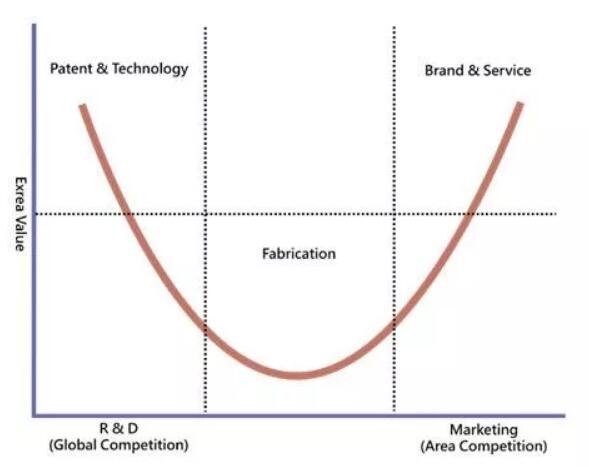
The manufacturing smile curve. Source: https://en.wikipedia.org/wiki/Smiling_curve
The same as the key technology of the fourth industrial revolution, 3D printingThe active adoption of the product will also help the manufacturing industry. As more and more domestic companies hope to have their own core technology and move on to a positive design path, these companies are showing a trend of transformation and upward development from the bottom of the smiling curve to the two ends.
With forward design and3D printingThe combination of advantages, the combination of artificial intelligence and process development, the combination of digital twins and production control, these factors actively promote3D printingThe in-depth integration with industrialization will extend the entire value chain along the two ends of the smiling curve, which will also help domestic innovative enterprises to promote my country’s smooth transition from a manufacturing country to a powerful country.
(Editor in charge: admin)
0 Comments for “SparkTALK: The opportunities and challenges of traditional manufacturing supply chain for 3D printing”