

According to reports from International Airlines,3D printing-Additive manufacturing In the manufacturing of composite materials, titanium alloys, superalloys and other materials used for supersonic passenger aircraft load-bearing and hot-end components, with the continuous breakthrough of additive manufacturing technology in manufacturing accuracy, speed, quality control, etc. , more unified and perfect in terms of standardized identification and certification, value chain integration, and additive manufacturing will help supersonic aircraft become a new high ground for commercial and manufacturing competition.
exist3D printing– Internationally, aerospace company Boom Supersonic has been awarded a contract worth up to $60 million from the United States Air Force (USAF) to accelerate its upcoming “Overture” supersonic aircraft. Development of sonic flight aircraft.
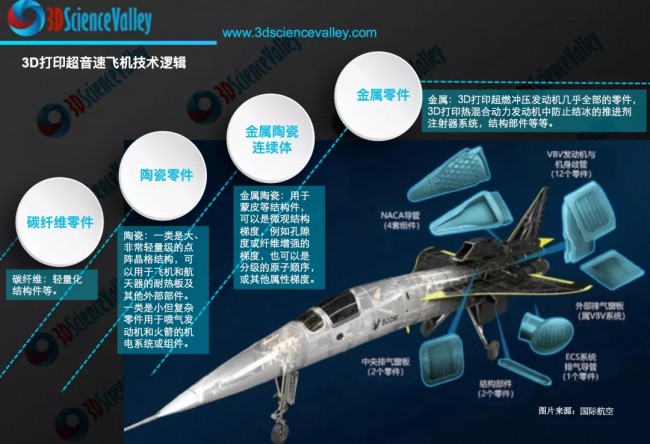 The application space of 3D printing supersonic aircraft © 3D Science Valley
The next generation of aircraft?
3D printing may be the key to winning the supersonic race, and there are many applications for 3D printing, includingMetal 3D Printing3D printing almost all parts of a scramjet, 3D printing a propellant injector system to prevent icing in a thermal hybrid engine, structural components, and more. It also includes the application of 3D printing in ceramics, carbon fiber materials, metal-ceramic continuum, etc. Due to the friction of the air, the surface of any vehicle will become very hot, and the hypersonic aircraft will continue to fly at a high speed exceeding Mach 5 for a long time in the adjacent space/atmosphere. The thermal environment in which the parts are located is particularly harsh. This makes the related parts have high requirements for the high temperature resistance of the material and the mechanical properties of the structure, and also has strict requirements for its space shape and its own weight. When traditional manufacturing techniques cannot meet the requirements,3D printing technologyIt opened up a whole new path for it.3D printing technologyBecause of its ability to quickly prepare parts with high material properties, special-shaped structures, and overall characteristics, it has been more and more widely used in the field of hypersonic vehicles.
 Funding and a brighter future
Aerospace company Boom Supersonic’s $60 million grant was awarded by the U.S. Air Force’s AFWERX innovation arm to help strengthen Overture’s aero and engine test programs, with its initial XB-1 demonstrator partially fabricated using 3D printing. The Overture will be able to carry up to 88 passengers at twice the speed of today’s airliners, while also running on 100% sustainable fuel, and is scheduled to enter service in 2030.
According to International Airlines, the XB-1 is a 1:3 scaled down prototype demonstrator of the supersonic airliner “Overture”, which has a passenger capacity of 55 to 75 people. XB-1 adopts a two-seat design, with a captain of 21.64m and a wingspan of 6.4m. It is loaded with three GE J85-15 engines and has a cruising speed of Ma 2.2. The XB-1 will undergo ground tests in the future and is scheduled to make its maiden flight in 2021 after a 100% carbon neutral test. At the same time, the company will complete the design and manufacture of the “Prelude” propulsion system and conduct wind tunnel testing and verification. When the XB-1 breaks the sound barrier in flight tests, Boom will finally confirm the “Prelude” design and launch a full-size supersonic airliner in 2025. It is reported that Virgin Group and Japan Airlines have already booked 30 of the aircraft. United Airlines ordered 15 aircraft.
It is understood that, as a potential future platform for the Air Force, “Overture” will provide a valuable time advantage, which is currently an unparalleled choice in the world.
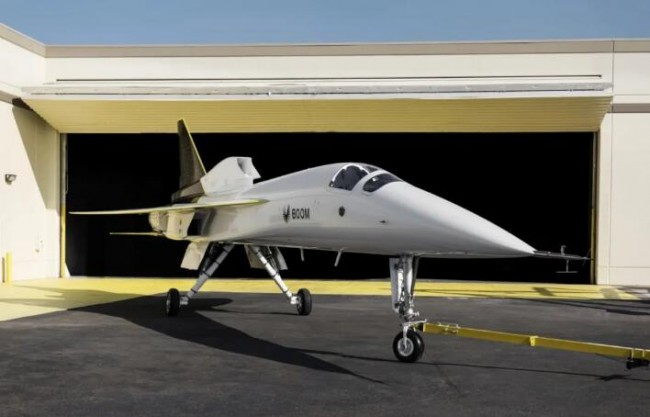 Boom Supersonic’s XB-1 Demonstration Machine © Boom Supersonic, Reference: International Aviation
Boom Supersonic was established in 2014. According to International Aviation, Boom announced the design and parameters of the XB-1 supersonic passenger aircraft in 2016, and publicly demonstrated its verification machine. In 2017, Boom revised the XB-1’s air intake, wing and vertical tail design, and then successively established partnerships with Japan Airlines, Advent Aircraft Systems, Stratasys, VELO 3D, and the U.S. Air Force. In 2020, Boom completed static wing loading tests, wing structure assembly and critical docking tests, and launched the second-generation demonstrator “XB-1” in October 2020 to prove the feasibility of the company’s 2.2 Mach Overture design. sex.
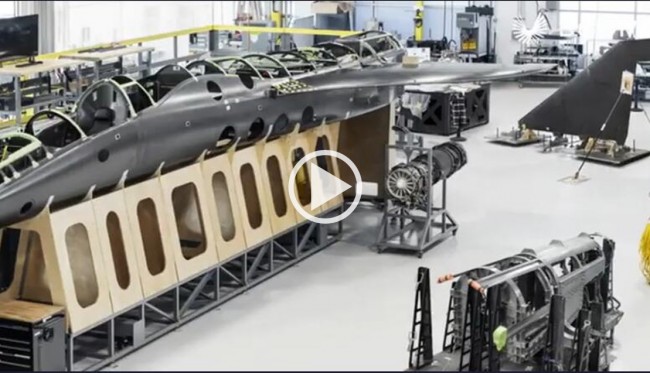
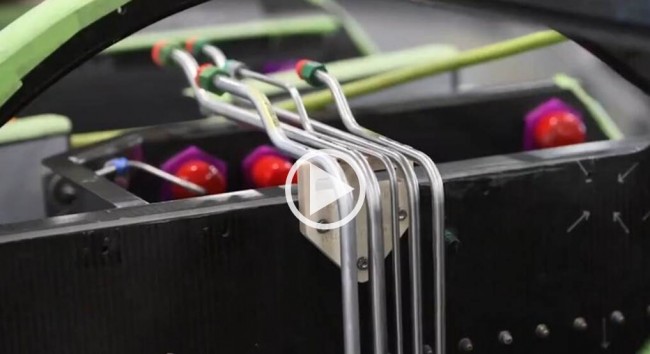 Boom aircraft development and assembly site
Although the prototype is only one-third the size of the Overture, its custom composite structure still contains more than 3,700 components, including the landing gear, flight control actuators and cooling system. To take on the daunting task of building this demonstrator, Boom Supersonic often 3D prints parts for rapid manufacturing.
3D printing technology as the core
From 2019, Boom has partnered with VELO 3D on the additive manufacturing of titanium alloy components, VELO 3D used the company’s “Sapphire” system to develop and manufacture key aircraft locations for the XB-1, according to International Aviation. Parts, these titanium alloy components are mostly used in engines, environmental control systems and structural components. Twenty-one titanium AM components have been installed on the XB-1 demonstrator, including: a variable bypass valve (VBV) system manifold that bleeds the engine compressor to the aircraft’s outer mold line (OML); Exhaust louvers for Environmental Control System (ECS) cooling the cockpit and electronics bay; louvers for directing secondary bleed air from the central air intake to the outer mold line; NACA duct and two diverter method blue structural components.
Metal 3D PrintingOn the one hand, 3D printed titanium parts are used in engine hardware, environmental control systems and structural parts. Its geometric design features include tall, thin outer walls with high aspect ratios, which are inherently difficult to manufacture by traditional processes (such as welding and casting) or most existing 3D printing techniques. Among them, VELO3D’s unique SupportFree printing process supports unprecedented design freedom and quality control, eliminating manufacturing constraints in aircraft design innovation.
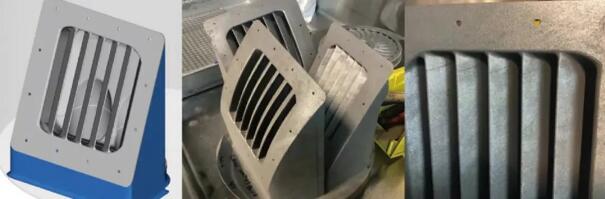 Each engine of the XB-1 is fitted with a variable bypass valve (VBV) system. This system can bleed compressor air to prevent engine stalling. The left is the digital model from the Flow preprocessing software; the middle is the three printed parts; the right is the window blade.
© Boom Supersonic, Reference: International Aviation
According to 3D Science Valley, the XB-1 development process takes full advantage of computer simulation software and 3D printing to make the design and manufacturing process faster and more efficient. The advantage of Boom is that it can iterate and test the design in hundreds of computer simulations, which is expensive and time-consuming compared to iterating on a design using a wind tunnel.
 Boom metal parts 3D printing
Engineers are able to run thousands of computer simulation calculations during the design process of the aircraft. Simulation and 3D printing are important to improve the design efficiency of Boom, based on the huge market demand for long-distance air travel, decades of technological progress and fuel efficiency improvements. , Boom is trying to operate a supersonic passenger jet with greatly improved economics, and it is said that it has obtained reservations from Japan Airlines and Virgin Atlantic through the Overture to be developed next so that the cost of the flight is comparable to the current business class travel.
Boom is also trying to increase environmental awareness by using the latest noise reduction technology, ensuring its engines are stable with low carbon emissions, geared towards sustainable jet fuel compatibility, and building a LEED-certified assembly line.
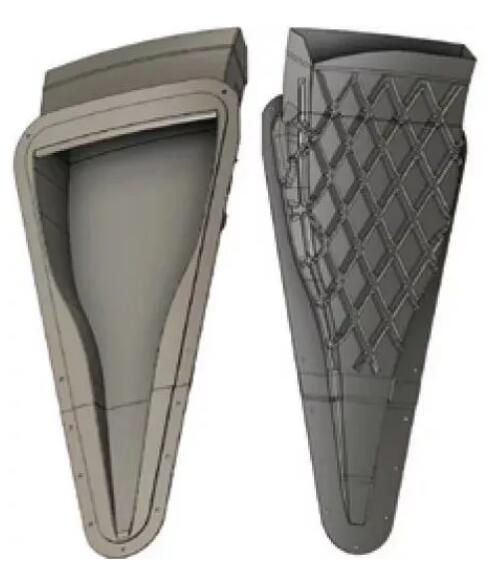 Creation of stiffeners in thin-walled NACA conduits to increase structural strength
© Boom Supersonic, referenced from: International Airlines
Boom also uses an advanced carbon fiber composite construction, currently a molded carbon fiber composite, which provides an excellent strength-to-weight ratio and better handles the high temperatures associated with supersonic speeds. These composites are approved by the Federal Aviation Administration (FAA). Boom also has a longstanding partnership with Stratasys that has allowed the two companies to move beyond rapid prototyping and produce end-use parts for the XB-1 and possibly Overture. Additionally, ceramic materials such as silicon oxycarbide (SiOC) can withstand incredible temperatures. If it is formed into complex geometric shapes by 3D printing technology, its use is even more special. 3D printing of ceramic materials could be the key to developing future hypersonic missiles and aircraft. Any vehicle surface can become so hot due to the friction of the air that making a hypersonic vehicle would require making the entire shell out of high temperature ceramics. Currently, no material can withstand the extreme heat and pressure of supersonic flight, and 3D printed ceramics may be the answer.
The U.S. Air Force has significantly increased its investment in Boom Supersonic as a three-year “strategic partnership,” which can continue to enhance Boom Supersonic’s rapid global transportation and logistics capabilities, especially in its executive transportation, intelligence, In surveillance, reconnaissance, special operations, or Pacific Air Force operations. Although the XB-1 has not flown since its launch in late 2020, Boom Supersonic has so far managed to secure $270 million to fund its development. In terms of commercial release, Boom Supersonic said the Overture is expected to enter production in 2023, followed by a launch in 2025, with passengers starting in 2030.
Layout the next-generation aircraft manufacturing camp
More and more airlines are turning to 3D printing to optimize the weight, lead times, and costs associated with manufacturing flyable aircraft parts. In a recent binder jet 3D printing trial, JPB Système found that the additive manufacturing technology was able to reduce the weight of some of its aerospace components by 30% and increase the manufacturing speed by 80%.
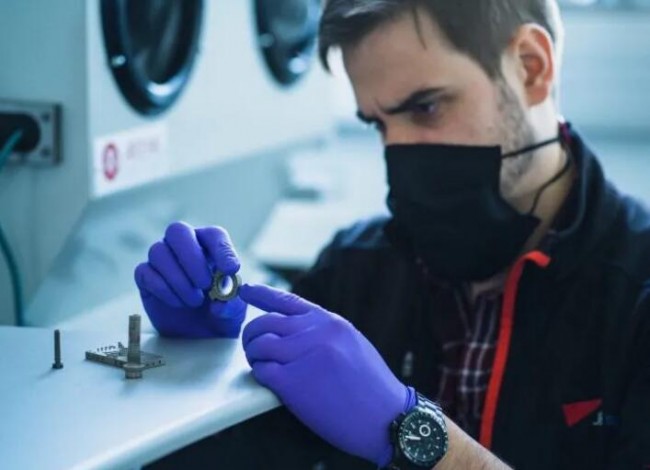 Companies like JPB Système have also started trialling 3D printing to produce flyable aerospace parts
© JPB Systems.
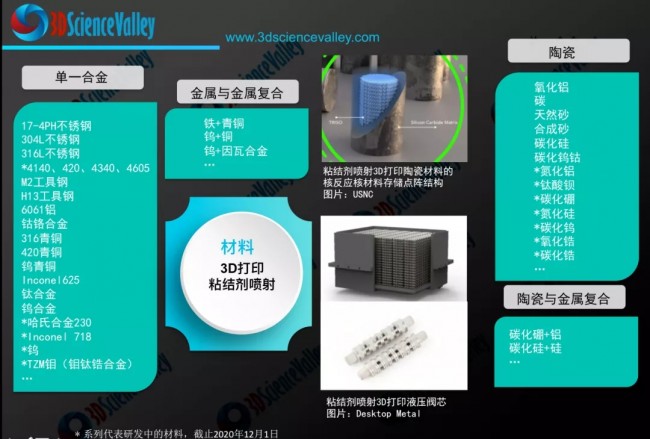 © 3D Science Valley
Internationally and domestically active companies in the field of supersonic aircraft engines include established large-scale companies and emerging start-up companies, including GE, Aerojet Rocketdyne, and Reaction Engines (the investors behind them include Boeing, Rolls-Royce, etc.), Raytheon, Northrop Grumman, and more.
3D printing is helping supersonic planes become a new commercial contender. According to 3D Science Valley Market Watch, Boeing and Rolls-Royce have invested £26.5 million (about $37.6 million) in Reaction Engines, a British company dedicated to 3D printing. SABRE engine and development of future supersonic travel engine options. Aerojet Rocketdyne’s new hypersonic engine built for NASA and the U.S. Defense Advanced Research Projects Agency (DARPA) successfully passed tests in 2018. GE has specially modified and optimized its Affinity turbofan engine, using proven supersonic flight technology, which can meet the supersonic flight requirements of Aerion AS2.
In December 2020, my country announced for the first time that the “scramjet engine” being developed can reach 16 times the speed of sound and reach anywhere in the world in 2 hours. It is known as China’s “monster-level” engine. In September 2021, Beijing Lingkong Tianxing Technology Co., Ltd. announced the completion of the A+ round of financing of more than 100 million yuan. It is reported that Lingkong Tianxing has rich experience in R&D design and engineering practice, and has mastered a number of core technologies such as pneumatics, control, and heat protection. .
(responsible editor: admin)
0 Comments for “The development of supersonic aircraft accelerates, and the US Air Force invests $60 million to develop “the world’s fastest supersonic passenger plane””