

Today’s aircraft structure is composed of many different materials. For example, the fuselage and wing structure of the Airbus A350WB are mainly made of composite materials with some metal parts. Here, according to the classic hybrid design, the parts are connected by bolts and rivets. This design leads to increased assembly time, effort, and cost. In addition, in this classic hybrid design, a large number of fasteners introduce unnecessary weight and stress concentration at the point of load introduction.
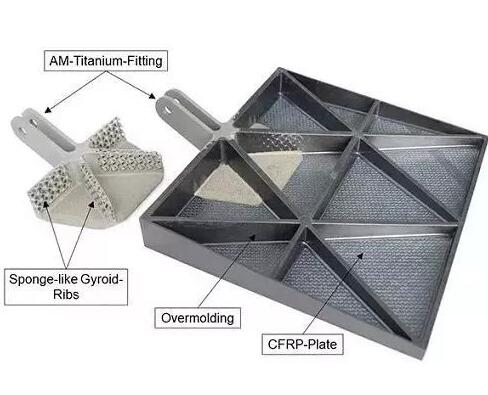
In the TOAST project, Premium AEROTEC (Augsburg, Germany) is the first-tier supplier of the A350 fuselage structure, and it proposes a new method to connect composite materials and metals. In this way, the shortcomings of the classic hybrid design with bolts and rivets can be eliminated. Premium AEROTEC uses a modern hybrid design to develop and manufacture a demonstrator similar to an aircraft brake pad structure in less than five months. It includes titanium load-in fittings and carbon fiber reinforced polymer (CFRP) thermoplastic composite panels manufactured by additive manufacturing (AM) and overmolded with thermoplastic composite materials.
The innovation of this demonstrator is that it can connect various materials without bolts or fasteners. This can only be achieved through the use of additive manufacturing and thermoplastic overmolding. The titanium fittings are designed with pins on the underside, and the reinforcing ribs designed in the spiral structure are easy to produce with AM. Then the AM titanium part and the thermoplastic composite sheet are placed in the thermoforming mold. In the thermoforming process, the injection molding step that follows presses the two components together. In this step, the V-shaped thermoplastic composite reinforcing rib is overmolded and pressed into the sponge-like convoluted reinforcing rib of the titanium fitting.
Connection by material (CFRP
0 Comments for “The potential of additive manufacturing design in the lightweight structure of future aircraft”