

DePuy Synthes, a subsidiary of Johnson & Johnson Medical, recently announced the approval of EIT Cellular Titanium 3D printingTechnology-manufactured intervertebral fusion product portfolio-CONDUIT, this product further expands Johnson & Johnson’s solutions in the field of treatment of degenerative spine diseases.
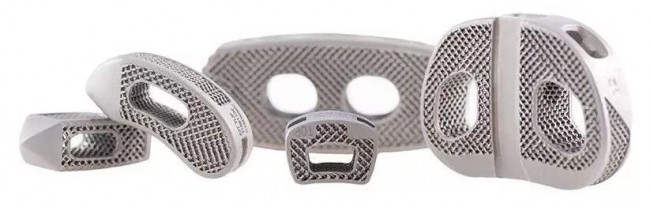
3D printingIntervertebral Fusion Product Portfolio-CONDUIT.Source: Johnson & Johnson
 Close to the microstructure and mechanical properties of cancellous bone
EIT is a spine that Johnson & Johnson announced in September 2018 to acquire3D printingProfessional manufacturer of implants. After the acquisition, DePuy Synthes, a subsidiary of Johnson & Johnson, has also strengthened its intervertebral implant product portfolio, including titanium alloys and PEEK implants for minimally invasive spinal surgery.Cellular Titanium implants manufactured by EIT use selective laser melting (SLM)3D printingProcess manufacturing, the implant has an open and interconnected porous structure, which is conducive to promoting bone growth. In 2017, EIT’s Cellular Titanium implant received 510(k) approval from the FDA. Prior to this, the implant has been used in 10,000 cases in more than 15 countries around the world.
Johnson & Johnson announced several major features of CONDUIT implants:
- Nano-scale surface roughness: In vitro studies have shown that compared with conventional titanium materials,3D printingTitanium porous material has nanometer-scale characteristics and shows increased adhesion of osteoblasts;
- The porosity is 80%, the porosity of human cancellous bone is 50%-90%, and the porosity of CONDUIT is similar;
- Elastic modulus is similar to cancellous bone;
- With the help of X-rays, CT scans and MRI medical imaging equipment, the space inside and around the implant can be clearly seen, and there is no obvious interference due to the structure of the intervertebral fusion cage.
The CONDUIT platform strengthens Johnson & Johnson’s3D printingThe promise of technology, Johnson & Johnson is becoming3D printingOne of the leaders in the field of medical devices, and with the help of3D printingTechnology builds advantages in product design, production of patient-specific products, as well as accelerating product launch speed, global supply chain transformation and material innovation.
Review
3D printingIs one of the strategic innovation technologies that Johnson & Johnson attaches great importance to. Johnson & Johnson will further strengthen its3D printingInvestment in research and development of implant materials. In February 2019, Johnson & Johnson subsidiary DePuy Synthes invested 36 million euros in its innovation center in Ireland to support a five-year project that will promote3D printingThe development of implant material science.The CONDUIT product portfolio recently announced by Johnson & Johnson is spinal implants.Spinal implants such as spinal fusion cages are powder bed metal3D printingTechnology is the fastest industrialized field in the field of orthopedic implant manufacturing.
Ushered in the international market after 20183D printingIn the wave of spinal implant approval and listing, in April 2019 alone, there were more than 10 spinal implant manufacturers in the market.3D printingThere are new actions in product development or new product launches, for example: ChoiceSpine released3D printingTitanium cervical spine implant Hawkeye TI, the first of Additive Implants3D printingTitanium alloy cervical spine spacer system has obtained FDA registration certificate, which is launched by Osseus Fusion Systems3D printingThe Aries-L lumbar interbody fusion cage has been used in clinical operations and so on.
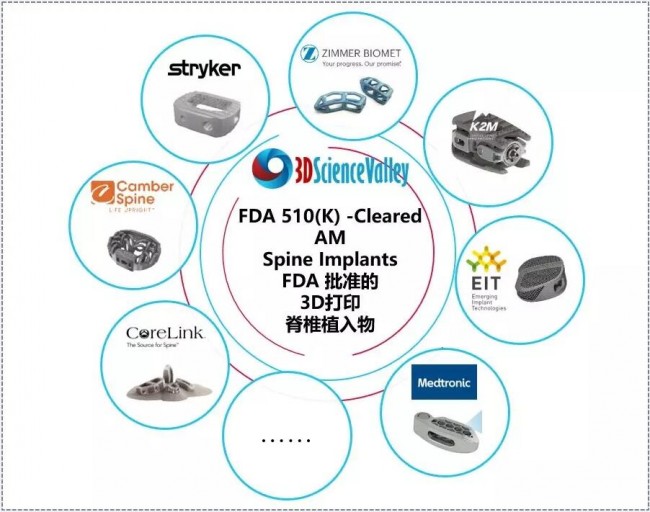
In the domestic market, spinal implants were also the first to be approved for marketing by the National Medical Products Administration (NMPA)3D printingOne of implant products.Beijing Aikang Yicheng Medical Equipment Co., Ltd.3D printingThe vertebral body prosthesis and interbody fusion cage obtained the medical device registration certificate between 2015 and 2016.
In addition, other and3D printingClinical trials related to spinal implants are also underway. For example, the team of Professor Xijing He from the Second Affiliated Hospital of Xi’an Jiaotong University and Blite have developed long-term cooperation and are working together3D printingResearch on the optimization design, personalized manufacturing and clinical application of cervical prosthesis, developed by Professor He Xijing3D printingThe new anatomical titanium cage has successfully completed clinical trials, and clinical follow-up data confirmed its application in subtotal cervical vertebral body fusion surgery3D printingThe new anatomical titanium cage is significantly better than the traditional titanium cage in terms of postoperative collapse rate and cervical curvature correction; Huatai Sanwei cooperated with the Department of Spine and Orthopedics of Southern Hospital3D printingThe personalized “artificial vertebral body/intervertebral disc integration” implantation operation was successfully implemented in 2018, and the two parties cooperated again in September 2019.3D printingArtificial vertebrae have also been successfully implanted.
The Medical Device Technical Evaluation Center of the State Drug Administration organized the drafting of the “3D printingGuidelines for the Registration and Review of Artificial Vertebral Body, and the draft for comments was released in September 2019.This guideline is applicable to those who have undergone vertebral body resection due to vertebral body disease or injury, for the purpose of fusion and fixation with the upper and lower normal vertebral bodies3D printingTitanium alloy artificial vertebral body products, including products using laser (selective laser melting, SLM) or electron beam melting (EBM), etc.3D printingTC4, TC4 ELI titanium alloy artificial vertebral body products of standardized specifications for bone grafts produced by additive manufacturing methods used in conjunction with the spine auxiliary internal fixation system.
“3D printingThe final determination of the Guidelines for Registration and Review of Artificial Vertebral Body will be improved3D printingThe quality and efficiency of the review of artificial vertebral products promote3D printingIndustrialization of technology in the field of spinal implant manufacturing.
(Editor in charge: admin)
0 Comments for “Johnson & Johnson launches new 3D printed intervertebral fusion products to expand spinal disease treatment solutions”