

China3D printingNet October 8th, in September 2019, US Secretary of the Army Ryan McCarthy (Ryan McCarthy) issued ainstructionTo support the continuous implementation of the troops3D printing. The directive sets out policies for the four official factions of the U.S. Army, specifically targeting “modernization through advanced manufacturing,” covering additive manufacturing, artificial intelligence (AI), robotics, and advanced composite materials. The goal states: “Advanced manufacturing will fundamentally change the way the Army designs, deliver, produce, and maintain material capabilities. This will enable the military to modernize the system while simultaneously enhancing its reserves.” As part of the directive, it was established in 2018 The United States Army’s Future Command was also responsible for developing a strategy to develop the Army’s additive manufacturing capabilities and appropriate security/intellectual property protection measures.
Additive Manufacturing in the U.S. Army
As the main source of funding for cutting-edge research and a center of excellence for scientific discovery and engineering technology, the US Army has established a variety of additive manufacturing models.US Army Corps of Engineers (USACE) and Marine Corps System Command (MCSC) used together3D printingCement construction base.The Army Research Laboratory (ARL) is being developed for3D printingOf high-strength alloys. At the end of 2018, ARL and the National Manufacturing Science Center (NCMS) also opened the Advanced Manufacturing, Materials and Process (AMMP) Center and Consortium in Aberdeen, Maryland.leading3D printingMachine OEM 3D Systems is an important collaborator of the center’s additive manufacturing project.
This year, the National Center for Defense Manufacturing and Processing (NCDMM), additive manufacturing accelerator America Makes, and Pennsylvania-based consulting firm Catalyst Connection jointly launched its AMNOW program to promote the integration of additive manufacturing into military logistics. Considering such developments, the new modernization directive will take effect from 2019 to 2029, which seems to be an effort to continue this momentum across the military.
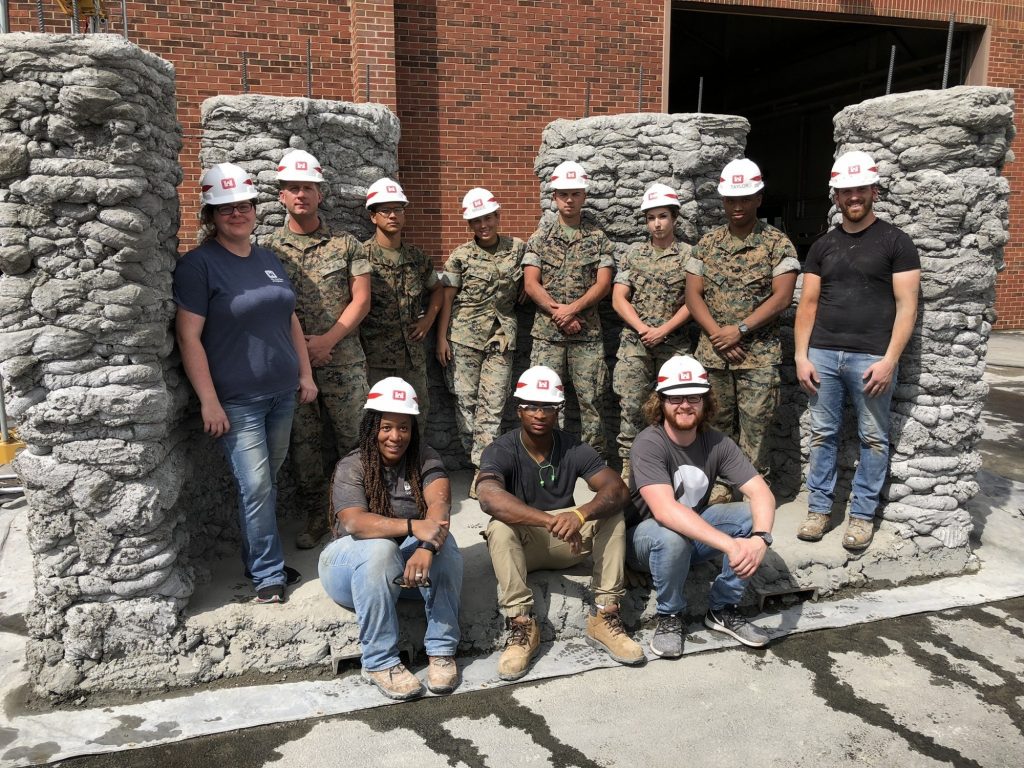
In progress3D printingGroup photo during the concrete process (the Marine Corps of the 7th Engineer Support Battalion and the engineers of the Construction Engineering Research Laboratory of the U.S. Army Engineers Group in the concrete bunker) Picture courtesy of the Chief of Staff of the U.S. Marine Corps: Michael Smith
U.S. Army implements Industry 4.0
The new policy outlines four goals for advanced manufacturing applications.
The first goal is to “allow the production of complex parts that cannot be manufactured using traditional processes.” Because of the rapid prototyping capabilities, the Army hopes to use this production to improve system performance and encourage innovation at “unparalleled speed.” The second goal discusses the development of an Industry 4.0 production network that enables “the connection between machines, products and people” to achieve “improved quality control, predictive maintenance and automatic ordering of materials”.The third goal emphasizes the ability of advanced manufacturing to “cope with the preparation challenges brought about by obsolete parts.” Although it involves more than just3D printing, But because the technology can be manufactured on demand, it is expected to benefit the most from this technology. Finally, the directive emphasizes the importance of integrating advanced manufacturing as early as possible in the system life cycle, adding: “Army organizations, including demand, research and development, procurement, maintenance, and contracting activities, must continue to invest in the policy outline to further Explore this.
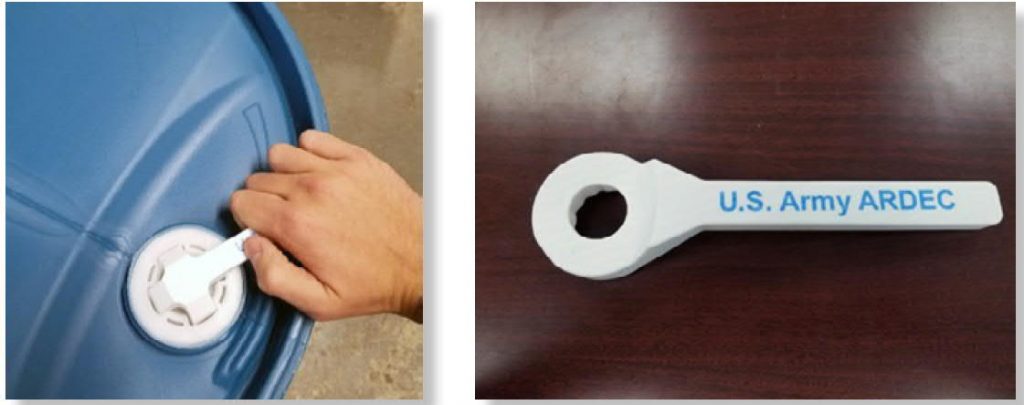
The U.S. Army printed a barrel opener and 3D wrench with Rize One. Picture from Rize.
Bruce Jette, the Army’s head of acquisition and assistant secretary of acquisition, logistics, and technology, will lead the policy and revise the Army’s regulatory standards over the next two years. Jeter will also work with the Army Materials Command, the Army Future Command and the Deputy Chief of Staff for Logistics to develop a detailed policy implementation plan, as well as another plan specifically for digital engineering.
China3D printingNet original article!
(Editor in charge: admin)
0 Comments for “The U.S. Army issues a directive to modernize through advanced manufacturing”