

China3D printingNet October 5th, Peter Palencia and Koroush Sasan of Lawrence Livermore National Laboratory recently published “Used for Optical Glass3D printingSol-gel-based nanoparticles” paper, they are using3D printingAnd printable titanium germanium silicon for further innovation in the field of high-performance optics. Ink made from colloidal sol-gel raw materials.Although glass is a very valuable material for scientists trying to transmit, refract, and reflect light, Palencia and Sasan pointed out the many challenges they face when using glass for work like theirs. In this study, they focused on the ternary formula of core-shell SiO2 nanoparticles coated with TiO2 shell and GeO2 nanoparticles, which can be used as raw materials for direct ink writing (DIW) lenses.

“At the atomic level, the refractive index of the glass can be adjusted to a certain value according to the composition of the oxide in the glass. For example, sodium oxide and titanium oxide can be added to the glass to increase the refractive index.” The introduction of different dopants into the glass will bring potential problems, because they will not only greatly change the optical properties of the glass, but also affect its thermodynamic stability and the overall feasibility of forming transparent glass.”
Through the additive manufacturing process, whether researchers use cells in tissue engineering or print on resin, the new “revolutionary method” can create a variety of materials.
“Although these methods have been successful in the production of other materials, they have not yet developed a reliable3D printingOptical lens method. “
“Bubble” is a typical challenge-creating stress and then causing rupture. Other methods have not been fully studied, such as glass created by UV curing ink. However, in the author’s previous research, although the use of fumed silica has achieved some success, it is still found to be an “inconsistent mixture that affects all aspects of glass.” It also tends to gather together and form too large to be squeezed. Out of the debris. Here, the researchers found a solution to avoid fumed silica and replaced it with sol-gel-based silica nanoparticles. It can be used for direct ink writing:
“Its transparency, refractive index and thermal expansion coefficient are comparable to commercial lenses.”
The authors found that to make functional optical glasses, they must rely on a combination of germanium, silicon dioxide and titanium. Dopants (germanium oxide and titanium oxide) cause the refractive index to increase while still maintaining functionality and performance.
Compared with the previously used silica ink, the new mixture has improved stability while still having to be extra careful during heating to avoid stress cracks.
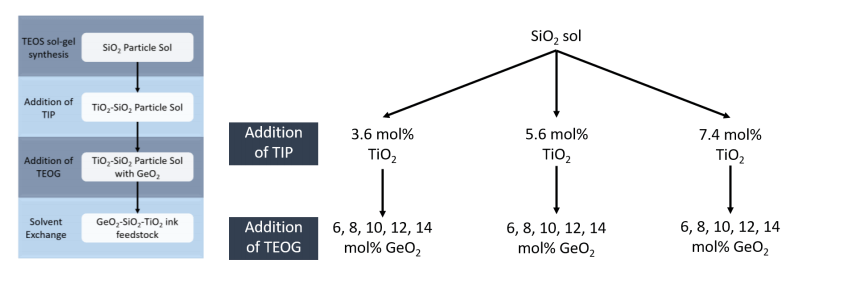
The preparation of GeO2-SiO2-TiO2 is mainly divided into four stages
The researchers concluded: “By changing the concentration of GeO2 and TiO2, we tested the feasibility of glass in terms of transparency and printability. The glass is transparent, up to 7 mol% TiO2 and 14 mol% GeO2. Similarly, through nanoparticles The zeta potential can see the higher colloidal stability of the glass.
Although these glasses are not completely free of cracks, a certain range of temperatures has been determined to be the cause of the cracks. Experiments are underway to optimize ternary glass and reduce cracking during heat treatment by adding surfactants. “
China3D printingOnline reviews:
From micro-optics to 3D laser lithography, to embedded geometry, it is often used in optical systems3D printing.What is your opinion, welcome to China3D printingDiscussion on the web forum www.3dddayin.com.
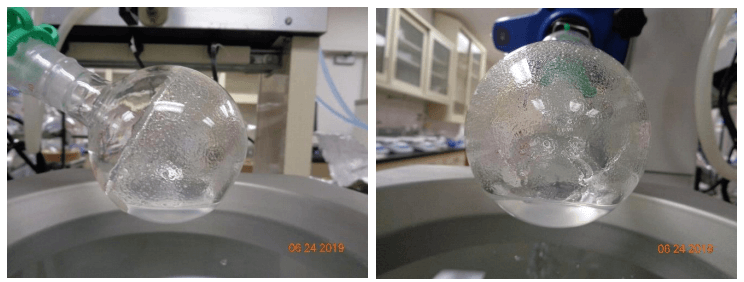 3D printingSol-gel-based nanoparticles” alt=”For optical glass3D printingOf sol-gel-based nanoparticles” />
[用于光学玻璃3D打印的基于溶胶凝胶的纳米颗粒]
China3D printingNet original article!
(Editor in charge: admin)
0 Comments for “Researchers found that germanium, silicon and titanium are stable to 3D printed optical glass”