

China3D printingNet December 14th, this year, the bioprinting community has found an improvementbiology3D printingThe method of precision.Even if the experts tell us3D printingOrgans may be unusable for a long time, but after witnessing major progress in 2019, we are still excited, which brings us closer to the possibility of functional, compatible and working organs and tissues, especially when researchers are in After significant progress has been made in different organizations and structures. Other relevant research highlights this year include new bio-printing machines and bio-inks, innovation centers and projects in the Australian bio-printing research community, and illustrations of bio-printing companies. These diagrams allow us to clearly understand the major biotechnology centers around the world. .
Bio-printer and bio-ink
In early November, researchers from the Wyss Institute of Bio-Inspired Engineering at Harvard University created a rapid multi-material3D printingmachine.Thanks to the unique3D printingWith the print head design, users can seamlessly switch between a variety of different materials at most 50 times per second.Called multi-material multi-nozzle 3D (MM3D) printing3D printingTechnology can completely change the process of printing complex structures, which is only carried out by Wyss3D bioprintingOne of many advancements.
In Europe, the former CEO and founder of regenHu, Mark Thurner (Mark Thurner) started his second company mimiX Biotherapeutics and started a new journey, which can use sound for bioprinting in the operating room. . A new biological processing technology called Sound Induced Morphogenesis (SIM) will be commercially launched this summer and has been proven through scientific evidence to provide a tissue engineering strategy that overcomes today’s obstacles, such as creating a suitable dense cellular network of microvessels change.
The new bio-printing machine was put into commercial use in 2019, including CELLINK’s complex structure bio-printing platform Bio X6 and Lumen X, which is a digital light-processing bio-printing machine developed by an experienced company in cooperation with Volumetric, aiming to enhance Inventions in Europe created more substantial vascular structures. Another Swedish biotechnology company called Fluicell has released a 2D and 3D high-resolution bioprinting technology called Biopixlar, which can create complex tissue-like structures and control the position of individual cells through a game board. The novel function allows users to control the system like an electronic game.
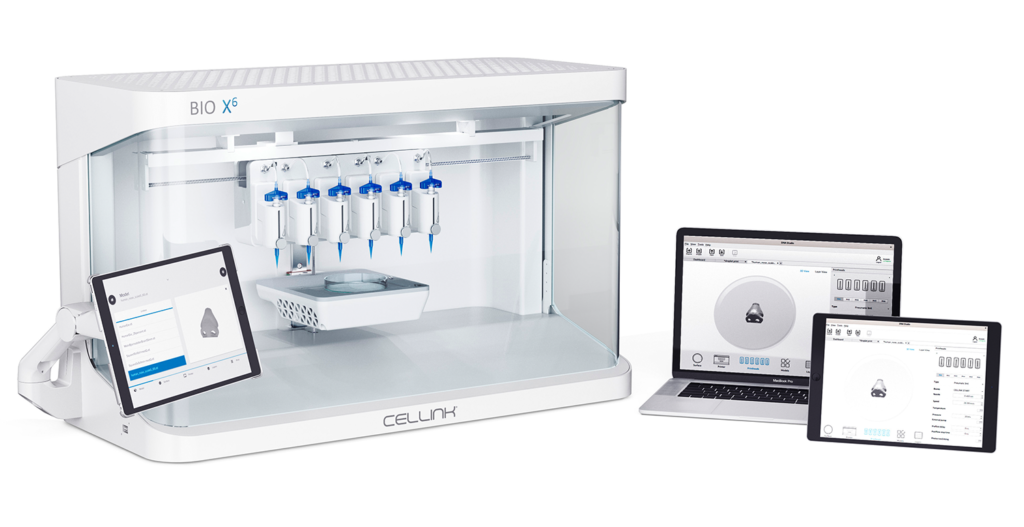
CELLINK BIO X 6 (Image source: CELLINK)
The development of Bioink this year is very rich.Companies like Allevi have produced bio-inks for the liver, and Biogelx has launched its first3D printingApplied synthetic bio-ink product series, Tessenderlo Group released their first gelatin bio-ink in its Claro series of tissue engineering products. As far as academic researchers are concerned, they are not lagging behind. A group of researchers from Texas A&M University has developed a 3D printable hydrogel bio-ink containing minerals that can provide protein therapeutics to control cell behavior Nanoparticles, and researchers at Rensselaer Polytechnic Institute and Yale University convert living human skin cells into bio-ink to print artificial skin and then grow its own vascular system. In the next few years, once these amazing advances enter the preclinical and clinical stages, we will see a greater revolution in the field of bioprinting.
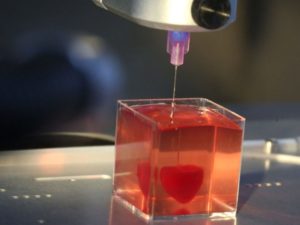
Heart tissue engineering(Image source: Tel Aviv University)
The story of Tel Aviv University tells the researchers3D bioprintingSignificant progress has been made in this regard. It introduced a new concept of engineered and fully personalized heart patches to repair heart defects. The heart is in the same title. Many people believe that a powerful heart beat that can replace organ transplants is coming.Although the researchers actually printed a cellularized heart-like structure with a natural structure to prove the potential of this organ replacement method, their work focused on a novel3D printingTechnology that uses patient’s stem cells and extracellular matrix (ECM) to create a personalized hydrogel as a bio-ink3D printingThick, vascularized and perfusible heart plaques that perfectly match the patient’s immune, cellular, biochemical, and anatomical characteristics, thereby regenerating previously defective or infarcted heart parts.
Some of our most experienced interviewees believe that in the long run, bioprinted organs may not look like our organs anatomically, but it is important that they have the necessary functions for human life.
Australia’s growing bioprinting landscape
This year, many of our stories in bioprinting revolve around Australia’s biotechnology, new laboratories and collaborative research results. The scientific research methods used by experienced professionals in the country consistently focus on teamwork and collaboration, which leads us to believe that they may be making a difference. The tireless efforts to recruit researchers among different universities and the countless opportunities for them to come together and participate in biotechnology this year to advance the field. As more and more students are interested in the engineering, design, medical and biochemical aspects of bio-manufacturing, comprehensive research laboratories across universities are booming. Gordon Wallace, a professor at the University of Wollongong, a leading expert in the field of bioprinting, and Jason Chuen, a vascular surgeon, the director of the 3D medical printing laboratory in Melbourne, have been actively leading and participating in conferences and seminars across the country.With breakthrough developments such as 3D Alek, bioprinters replicate human ears for patients with small mouth disease and create their own bio-inks in the laboratory, researchers have learned that the success of their work comes from sharing knowledge and creativity among peers .
China3D printingInternet Comments: Overall, 2019 was a record year. Looking ahead to 2020, we can expect that bioprinting research and development and the collaborative ecosystem between scientists will continue to proliferate.We should also expect top research institutions and leading companies to continue to mobilize new technologies to take advantage of3D bioprintingAnd continue to study the function of regenerative medicine tissues. Finally, it is important to carefully analyze the growing popularity of emerging methods that may stimulate emerging trends in the field.
China3D printingnetworkOriginal article!
(Editor in charge: admin)
0 Comments for “Review of 3D Printing in 2019: Biological 3D Printing”