

China3D printingNet, December 23, a group of researchers explored the development of soft robotics technology and outlined their findings in the recently published “Closed Loop 4D Printed Soft Robots”. When emphasizing the speed of development in this field, the author clearly pointed out: from materials and modeling to performance control, etc., many different levels of research and development are involved. 3D printingExcellent custom features can be achieved, but by extending the process to new heights through 4D printing, researchers can add more features to robotics.
Closed-loop 4D printing allows researchers to enhance soft robots with sensors, actuators and controls to achieve better performance overall. The author uses a data-driven machine learning model to integrate these details into electronic innovation, which is designed to handle new levels of tasks, including:
1. Grab
2. Sort
3. Climbing or crawling
4. Check
5. Search and rescue
6. Drug delivery system
According to China3D printingWang understands that a soft robot similar to origami can provide the variable stiffness required for a specific task, thereby having higher efficiency and flexibility, which traditional robots cannot handle. Closed-loop 4D printed soft robots can also be used for autonomous surgery, laparoscopy and endoscopy.
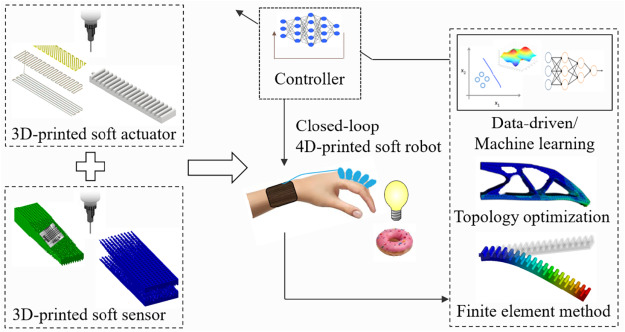
Closed-loop 4D printed soft robot diagram.
Machine learning plays an obvious role in 4D printed soft robots, thereby alleviating some of the challenges involved in “diversified manipulation tasks”. Machine learning can be used to develop such robots in the manufacturing process, and algorithms can be used to speed things up. Performance optimization, such as the viscosity and orientation of the part.
The researchers said: “Through the integration of physical models, machine learning uses sparse data sets in a statistical learning framework to predict material and3D printingProcessing parameters to improve3D printingSpeed and fidelity. “
use3D printingAt the time, the following functions can be introduced:
1. Directional anisotropy
2. Variable stiffness
3. Spatially heterogeneous mechanical strength
The use of machine learning is beneficial to robotics in this field. It provides larger size and more functions, and has a variety of available control mechanisms: open-loop controller, closed-loop (with embedded soft sensors), etc. .
“The mechanisms and materials used to construct soft robots are similar; therefore, a learning strategy that deals with nonlinearity and high agility can be used to inspire control.” The researchers explained.
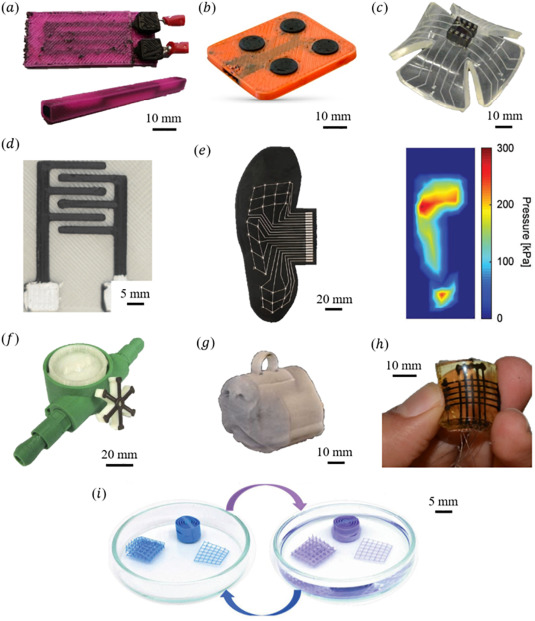
3D printing
Sensors and their applications in 4D printing soft robots” alt=”
3D printing
Sensor and its application in 4D printing soft robot” width=”620″ height=”720″ />
3D printingSensors and their applications in 4D printing soft robots. (A)3D printingIntegrated strain sensor (reproduced by Copernicus Publications on behalf of AMA[42]); (b)3D printingSEMG electrode (reproduced by Copernicus Publications on behalf of AMA[42]); (c) In the jellyfish soft robot3D printingPiezoelectric sensor (via SPIE [67]Copy with permission); (d)3D printingElectronic tongue sensor (via Frontiers [110]Copy with permission); (e)3D printingPressure sensor (reproduced with permission from John Willey and Sons[71]); (f)3D printingFluid flow rate sensor (by IOP Publishing [98]Copy with permission). (G) Used for gas detection3D printingDog nose (by Nature Publishing Group[109]Copy with permission); (h)3D printingFlexible tactile sensor (via Springer [58]Copy with permission); (i)3D printingThermochromic and solvent-induced color sensor (reproduced with permission from John Wiley and Sons)[100]).
Now only3D printingThe sensor is advanced enough to be printed at the spatial level. For 4D printed robots, these functions can be “classified and introduced”. Amphibious soft robots also have the potential to achieve a wide range of applications.
China3D printingInternet comment: “Despite the problems,3D printingThe soft sensors and actuators are integrated with machine learning algorithms and FEM to realize 4D printed soft robots.integrated3D printingThe actuators and sensors are feasible, but are limited by the nature of the materials used. Therefore, the future of enhanced closed-loop 4D printed soft robots depends on the integration of suitable materials, machine learning methods and control algorithms.From new designs and frameworks to continuous customization and different materials, soft robotics technology will always be a research hotspot. “
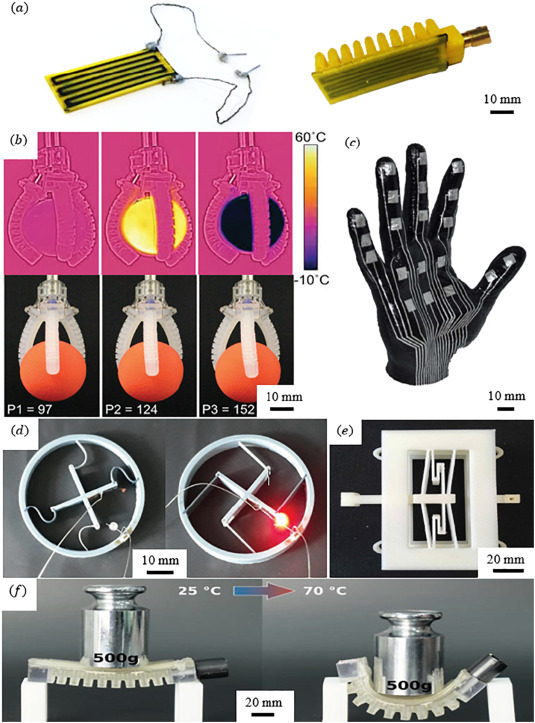 3D printingSoft sensors and actuators” alt=”Integrated3D printingSoft sensors and actuators” width=”620″ height=”838″ />
Integrated3D printingSoft sensors and actuators: (a) in the pneumatic soft actuator3D printingEmbedded sensor (via SPIE [126]Copy with permission); (b) Those with printed embedded sensors3D printingSoft Claw (Reproduced with permission from John Wiley and Sons[9]); (c)3D printingOn the prosthesis3D printingTactile sensor (approved by the American Chemical Society[34]Copy with permission); (d) 4D printed multi-stable thermal actuators (via John Wiley and Sons [150]Copy permission); (e) Bistability3D printingSoft actuator (via MDPI [148]Copy with permission); (f) with integrated Joule heating circuit3D printingVariable stiffness soft actuator (reproduced with permission from John Wiley and Sons[151])
China3D printingNet original article!
(Editor in charge: admin)
0 Comments for “Scientists use 4D printed soft robots to push robotics manufacturing to new heights”