

In the field of industrial manufacturing, especially for a highly automated and efficient factory, the high stability of equipment is very important. Otherwise, a failure of one equipment or inconsistent quality of multiple equipment will cause Large-scale production is in a quagmire.
Generally, people’s attention to device stability is generally focused on the device itself. However,3D printingThe inherent digital features make online real-time adjustment possible.In this issue, 3D Science Valley and Gu You come to experience the digital twin to realize HP3D printingSelf-optimization of the machine.
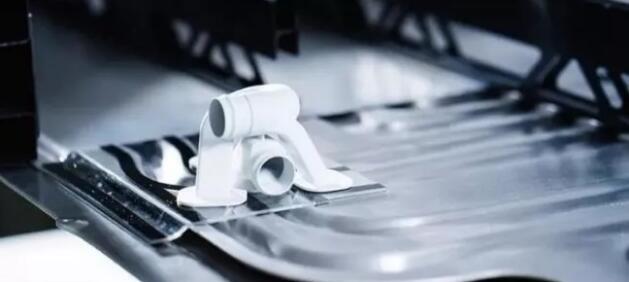
3D printingCoolant distributor
 Realize lightweight and complex design
Just in September 2019, the German engineering company EDAG demonstrated the3D printingThe active coolant distributor was installed in the “EDAG SCALEbat” battery housing for the first time.
This application case combines HP’s industrial-grade HP Jet Fusion 5200 3D printingThe equipment is integrated into Siemens’ digital enterprise solution, which can produce this kind of coolant distributor faster, more economically, and more sustainably than before.The large-scale production concept based on up to 300,000 pieces proves that it has passed the mass production3D printingThe economic feasibility of manufacturing parts.The large-scale production of up to 300,000 pieces challenges not only the stability of the equipment itself, but also the application capabilities of the digital twin.In order to better understand the role of digital twins, we now review the cooperation between HP and Siemens.The cooperation between HP and Siemens is comprehensive, including overall product lifecycle management (PLM), AM-additive manufacturing plant optimization, industrial3D printingAnd data intelligence, manufacturing execution and performance analysis.For example, HP’s Jet Fusion 5200 series industrial3D printingThe system is integrated with Siemens Digital Enterprise products, including Siemens Digital Twins, Siemens Teamcenter for PLM, Tecnomatix Plant Simulation, Simatic IT for manufacturing execution, and MindSphere for performance analysis and industrial Internet of Things.
Such cooperation is to help automotive and industrial customers to create high-quality3D printingComponents to realize unique product designs, new applications and digital factories
So at present, what role does the Siemens digital twin play in the operation of HP’s equipment?
Just like conventional manufacturing, proper cooling is also essential for additive manufacturing. Siemens supports HP for its Jet Fusion 5210 3D printingThe machine develops an ideal ventilation solution.
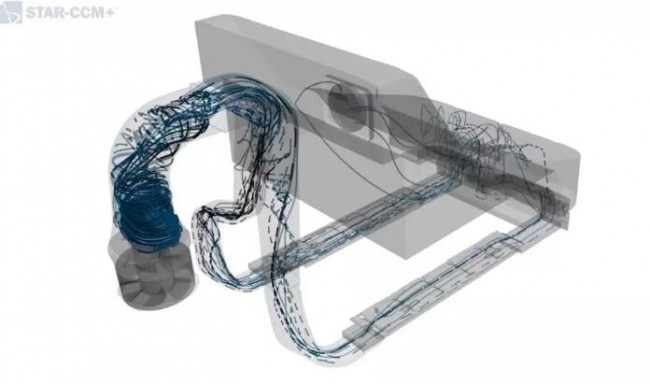
In a specific case, based on a digital twin, it is now possible to simulate and analyze airflow patterns. This optimization process is interactive, and the data generated during the manufacturing process becomes the topological basis for further automatic optimization of the cooling air flow-this method increases the airflow efficiency by 22%. In addition, the printing speed can be increased by 15% without the risk of overheating.
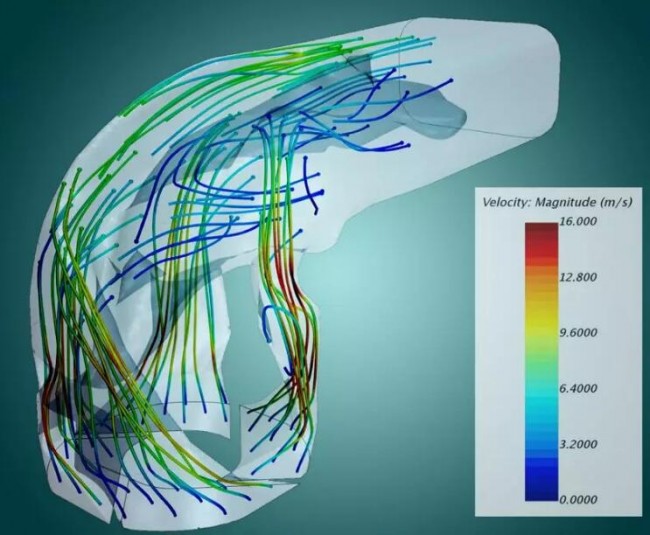
But this is not all: it is also possible to reduce the processing parameter development time from four months to only four weeks. And Siemens’ additive manufacturing and digital solutions have reduced product manufacturing costs by as much as 35%.
The digital twin simplifies production planning and manufacturing processes. Take an example: In order to save resources during production, the software automatically calculates the ideal print layout space. In addition to capacity allocation and material consumption, the software also optimizes personnel requirements, which facilitates the expansion of orders.
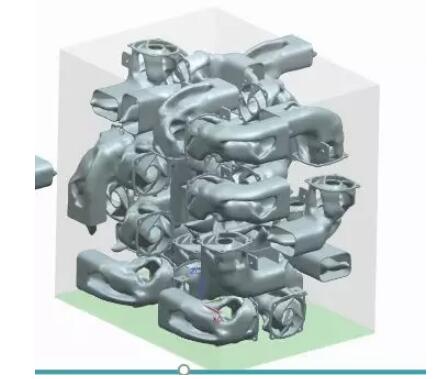
If the production volume of future orders is known, production can be simulated in advance: Siemens uses programs to calculate and arrange all aspects related to effective production-including the required3D printingThe number and layout of equipment and automated guided vehicles (AGV) and the ideal distance between each machine. Later, during mass production, Siemens MindSphere IoT industrial IoT system monitors the printing process-analyzes the collected data in real time to ensure a smooth production workflow.
Review
3D printingWill empower value creation,3D printingIt will bring the discrete characteristics of manufacturing, and how to organically link discrete manufacturing and achieve seamless integration between different manufacturing processes, this is3D printingEnter the “infrastructure” of large-scale industrialization.This is also what all domestic enterprises must3D printingNecessary homework that needs to be done to realize industrialized application.
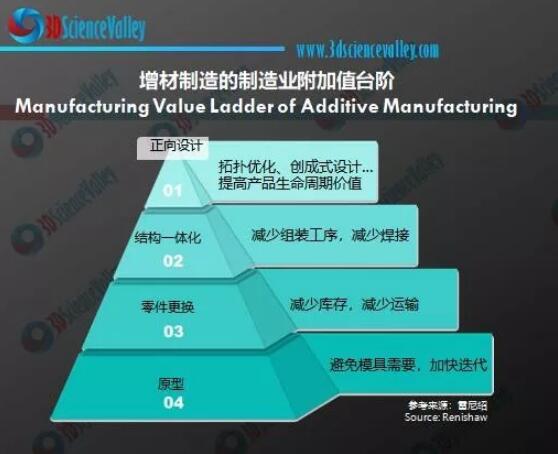
3D printingAnd the added value of the manufacturing industry.Source: 3D Science Valley
And another key element is artificial intelligence. Another typical case is DMG MORI-DMG Mori Seiki’s application of artificial intelligence to the preparation of laser melting SLM series of selected areas, reducing the parameter preparation time from several weeks to several. Today, DMG MORI’s OPTOMET software automatically calculates process parameters through artificial intelligence, and integrates OPTOMET software through the CELOS system. This software is highly intelligent. It only needs to enter the powder parameters and processing requirements, and the system will automatically optimize the processing parameters. It saves the time for manual parameter setting and avoids the production of a large number of scrap parts caused by manual parameter setting.
Forward design and3D printingThe combination of advantages, the combination of artificial intelligence and process development, the combination of digital twins and production control are the impetus3D printingThe “troika” of industrialization.With positive design empowered at the source of value creation; with3D printingEnter the “infrastructure” of end-to-end solutions required for discrete manufacturing; with a series of simulation and machine learning tools such as digital twins and in-process control;3D printingOnly then can we enter the benign ascending track of development and put on the wings of soaring.
(Editor in charge: admin)
0 Comments for “See how the digital twin realizes the self-optimization of the HP 3D printer?”