

At the TCT Shenzhen Exhibition Summit Forum just past, we saw the design and3D printingThe combination of advantages, the combination of artificial intelligence and process development, the combination of digital twins and production control are the impetus3D printingIndustrialized “troika. With positive design empowered at the source of value creation, there is3D printingEnter the “infrastructure” of end-to-end solutions required for discrete manufacturing, with a series of simulation and machine learning tools such as digital twins and in-process control.3D printingOnly then can we enter the benign ascending track of development and put on the wings of soaring.
So for those who have embarked on the new industrial revolution3D printingFor Siemens on the road to industrialization, what is the situation? How does Siemens achieve effective control and consistency of product quality? In this issue, let’s take a closer look at Siemens’ digital efforts and progress in the new industrial revolution.
Source: Siemens
 The new industrial revolution that reduces delivery time by up to 90%
In February 2016, Siemens invested more than 20 million euros to transform a school moved out of Finspång, Sweden into a Siemens industrial gas turbine3D printingR&D bases and factories.The Siemens Finspång plant in Sweden passed3D printing-Additive manufacturing is used in the development, maintenance and production of gas turbines.
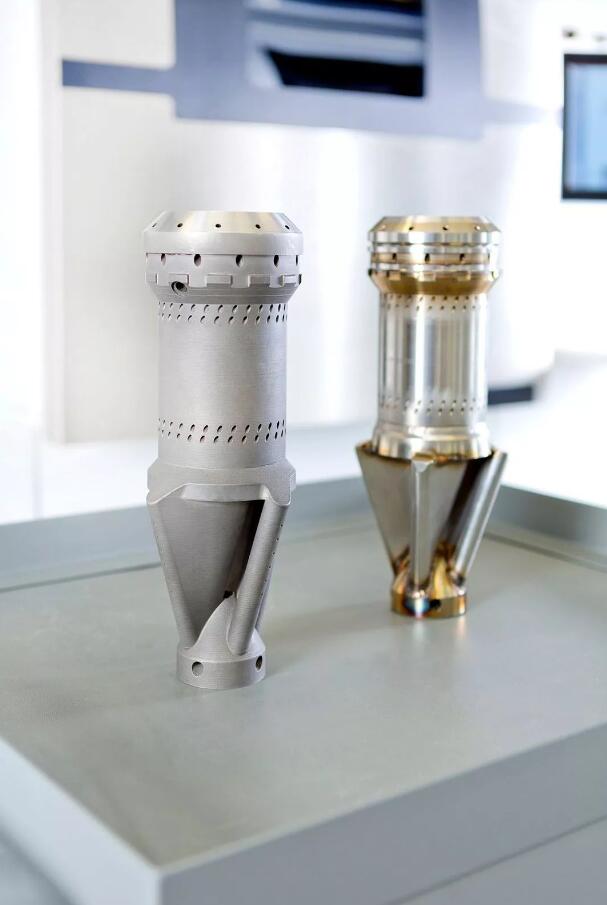
The Finspång plant currently uses3D printingThe manufactured gas turbine parts are concentrated in the combustion chamber. Front end of SGT-800 combustion chamber.In the traditional production process, this part is composed of 13 parts and 18 welding points.3D printingTechnology prints it as a whole, shortening the production time from several months to one or two weeks.
In the past, the burner manufactured by the casting process is welded by several disassembled parts, and only a few percent of hydrogen can be mixed in the air through this burner.Selective laser melting3D printingThe technology provides a wider space for the design and optimization of the burner. The optimized burner has an outer wall and an inner wall of a frame structure. This complex double-wall structure component is finally passed through metal3D printingThe equipment is manufactured at one time, and there is no need to weld several separate parts together.
For a long time, additive manufacturing was only used to produce prototypes. Today, the situation is completely different. After several major digitalization plans, the Siemens Finspång plant became the first workshop in Sweden to focus on industrial additive manufacturing. Today, Siemens Industrial Turbomachinery has become a global leader in the field of additive manufacturing of metal components.
3D printingThe thickness of each layer of metal is between 0.02mm and 0.04mm. According to the data obtained in the process monitoring, the algorithm can detect the loopholes in each layer, and then realize self-correction, so as to cost-effectively mass-produce highly complex components.
Delivery time can be reduced by up to 90%. With the enhancement of production control capabilities, Siemens can more easily customize and simplify products, while reducing manufacturing and maintenance time. The development process can be shortened from years to months or even weeks.
However, it is not uncommon for Siemens to have problems at the beginning of new production. These problems are undoubtedly complicated and painful if they are solved manually. Siemens uses algorithms to detect errors in the process. Once errors are found, the machine can immediately correct or stop. Printing work, thereby avoiding a large amount of waste generated by unqualified parts.
In addition to process control, many different programs and software are used in the manufacturing process, so an MES manufacturing execution system is required. With the MES system, you can mainly avoid two complicated manual tasks. One is the call between different software in the modeling and simulation process, but the seamless connection between the software is formed. The second is to avoid tedious manual calculations during the planning and arrangement of tasks, but to realize automated task scheduling and tracking through the MES system.
In general,3D printingIt is the main driving factor that brings the next generation of the industrial revolution. The main reason is that additive manufacturing brings the economy and flexibility of small batch production, the possibility of personalized customization, and the feasibility of production of complex parts. Not only has it changed the impression of the original product design, it has also brought about changes in the supply chain, shortened the time to market for products, and is more environmentally friendly.
3D printingIn the field of precision equipment such as gas turbines, there is plenty of room to play, from the crystallization control of alloys to the realization of the precision and complexity of parts.3D printingIt not only promotes industrial redesign, but also saves production resources in the production and repair process, and by improving the performance of the final product, it brings greater power generation benefits to play the value of four or two.
The data and algorithms in the additive manufacturing factory are like the nerves of the human body, connecting and communicating with the brain to form effective thinking and action abilities.While pulling3D printingThree carriages for industrialization: positive design and3D printingThe combination of advantages, the combination of artificial intelligence and process development, and the combination of digital twins and production control will work together to promote the vigorous development of additive manufacturing.
(Editor in charge: admin)
0 Comments for “Siemens 3D printing factory in Sweden is making progress on the road to the new industrial revolution”