

China3D printingNet, October 1st, for more than 100 years, the treatment of heart disease has meant opening the patient’s chest cavity to enter the heart through open heart surgery. The procedure usually takes three to six hours and is accompanied by a lot of pain and high-risk surgical complications. The most important thing is that the patient must be in good health in order to undergo the operation. Therefore, the use of minimally invasive surgery has become extremely important. Just last month, the US Food and Drug Administration approved the procedure for low-risk patients who need to replace damaged valves.This is important because aortic stenosis is the most common valvular heart disease in the United States, afflicting 1.5 million people, many of whom cannot or do not want to undergo open heart surgery, then use3D printingTo help diagnose and treat complex heart disease is a feasible option.
Recently, VA Puget Sound (part of the U.S. Department of Veterans Affairs) and the University of Washington (UW) School of Medicine announced a two-year collaboration to develop3D printingThe new use of this can help cardiologists to better observe the unique and complex anatomy asProvide services to patients and improve access to new minimally invasive treatments.It turns out that this type of surgery can help reduce hundreds of millions of dollars in health care costs every year and make surgery safer by reducing the pain associated with surgical complications. Today, with the help of3D printing, Everyone can do it easily.
The two organizations will share3D printingMachines, 3D materials, software, and professionals composed of physicians, researchers, and engineers to quickly develop new protocols to plan procedures, such as creating patient-specific treatments for mitral valve disease3D printingModel.
” 3D printingIt can benefit many aspects of structural heart disease, including diseases that affect the four valves of the heart (aorta, mitral valve, tricuspid valve, and pulmonary artery).Each valve has a different structure and different challenges to interventional methods. Here, it can be visualized3D printingThe anatomy can indeed play a role. “Said VATH, a radiologist at VA Puget Sound.

Seattle’s VA Puget Sound health care system facility
VA is the largest integrated medical institution in the United States and has the most extensive hospital-based3D printingOne of the networks. Veterans Health Administration (VHA)3D printingI’ve seen it with my own eyes3D printingMany benefits, fromkidneyModels to inform veterans with kidney cancer preoperative planning, and even specialized foot orthoses can help prevent avoidable amputations. Veterans of type 2 diabetes. Cardiologists will be able to use a life-sized 3D model of their heart to better prepare for the upcoming surgery and help their patients understand the type of treatment and surgery they will undergo.
3D printingMedical models can promote patient understanding, Physician training, disease diagnosis and surgical planning. The next area will be to find implants and surgical cutting guides that match the patient.Finally, we are exploring bioprinting, that is, structures that can support or consist of living cells3D printing. “
Both UW Medicine and VA Puget Sound use Materialize Mimics licensed by medicine 3D printingSoftware and GE Advanced Workstation Volume Share software.Both institutions have a variety of3D printingmachine. VA Puget Sound is equipped with:
Stratasys F370 FDM printer
Stratasys Mojo FDM printer
Stratasys Objet 30 Prime Polyjet printer
Stratasys Objet 350 Connex3 Polyjet printer
Formlabs Form2 Photopolymerization (SLA) Printer
At the University of Wisconsin School of Medicine, research scientist Dmitry Levin (Dmitry Levin) manages a nationally recognized3D printingLaboratory, the laboratory has produced more than 100 patient-specific models to guide cardiologists and surgeons in their decision-making.In order to execute their project, the researchers at UW Lab use the following3D printingmachine:
Dremel FDM printer
Formlabs Form2 Photopolymerization Printer
UNIZ SLASH pro Photopolymer printer
NewPro 3D Optical Polymerization Printer
Prusa i3 FDM printer
Z Corp Zprinter 250 color3D printingmachine
By joining VA, Levin stated that they are combining “all our collective expertise into a unified effort to provide patients with personalized cardiac care based on their unique needs.Now that the FDA has extended the catheter-based method to patients with low surgical risk, for the availability of aortic valve replacement (TAVR), we will see more cases from3D printingBenefit from the model.In addition to improving the understanding of the patient’s anatomy, (3D printing) It also allows us to know which catheters and replacement valves will be suitable, and how to best approach specific structures. This knowledge can save the patient the cost of equipment and operation time. “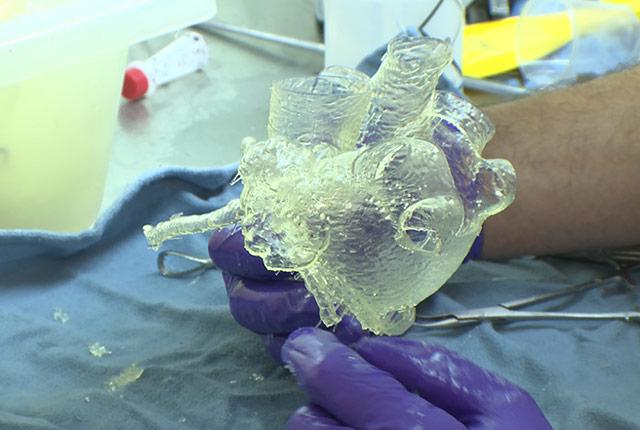 3D printingreplica” alt=”The accuracy of the patient’s heart3D printingCopy” />
Research scientist Dmitry Levin (Dmitry Levin) has the precision of the heart of UW Medicine patients3D printingreplica
Both VA Puget Sound and UW Medicine3D printingEarly adopters of technology are regarded as leaders in their respective fields. The development of this research agreement is expected to benefit not only the 9 million registered patients of VA and the vast area of UW Medicine patients, but also patients outside of these hospital networks.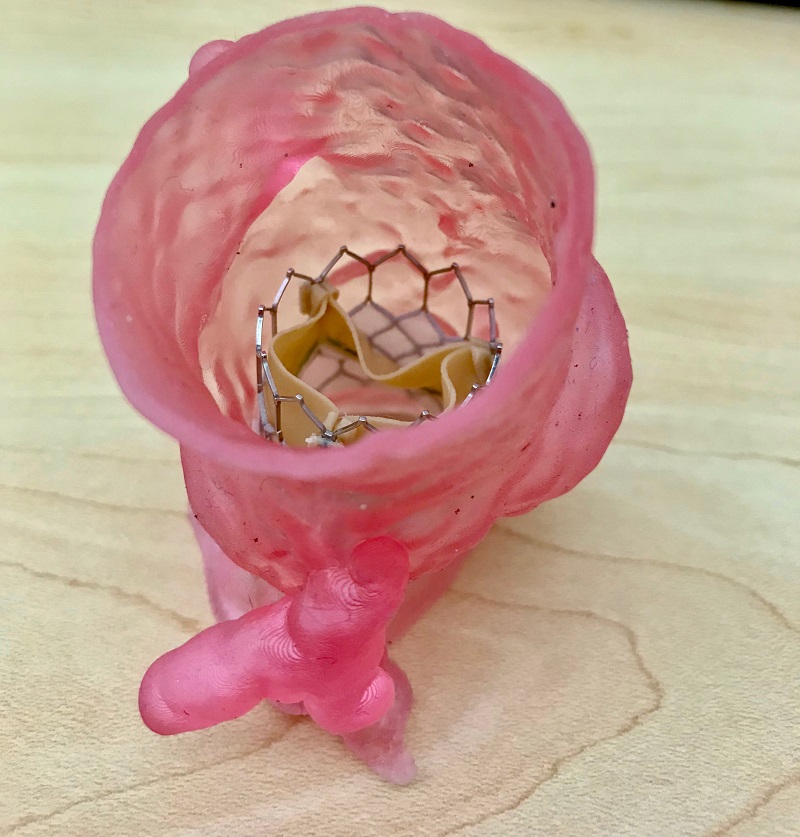
3D aortic valve with TAVR bioprosthesis
China3D printingnetworkI believe that heart disease, diabetes and cancer are all3D printingChronic diseases are being solved, and in the future, hope to continue to expand the coverage of this technology to solve other health problems.In the United States, 18.2 million veterans can get from3D printingBenefited from the advancement, in addition, due to ongoing research, morePatients alsoWill get help indirectly. This is for global healthcare,This is a win-win situation.
(Editor in charge: admin)
0 Comments for “The U.S. Department of Veterans Affairs and the University of Washington collaborate to promote the development of 3D printing for heart disease”