

China3D printingNet October 1st, Katherine Vanesa López Ambrosio (Collins State University Advanced Materials Discovery Institute) has studied the use of bone regeneration in the recently published “Hydroxyapatite structure by additive production of polymers through extrusion”3D printingImplants. Although surgeons have been using conventional implants and have achieved some success, there is always the risk of infection and the possibility of lack of compatibility. The cost of traditional technology is also high, because fractured bones require implants to guide new growth.
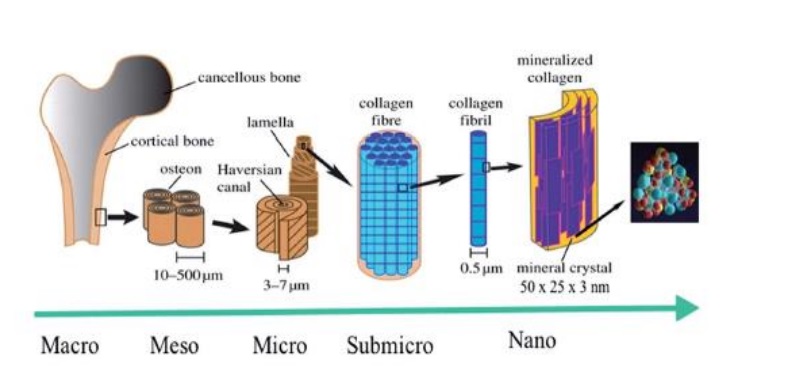
Hierarchical morphology of bones
By using hydroxyapatite (HAp), researchers see the potential for success, but need to produce synthetic HAp implants.In this study, the research team created a3D printingThe hydroxyapatite photopolymerizable resin can produce complex shapes without support. Ambrosio and researchers have developed a HAp-based photopolymer slurry for3D printingHap green body:“The resulting HAp structure maintains complex details. Compared with the fully dense HAp, the relative density is ~78%, and the size shrinkage rate is ~15% compared with the green body. It is found that the sintered HAp structure is cell-free for ADSCs cells. toxicity,The bending properties of the HAp green body and sintered structure were also determined. It was found that the bending strength of the green body was about 30.42MPa, which was equivalent to that of trabecular bone. “
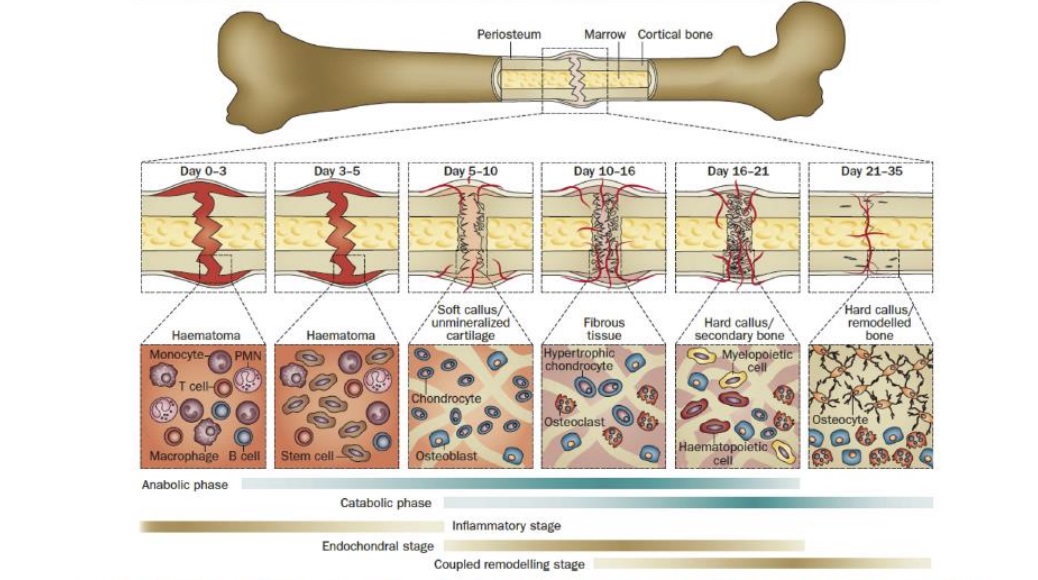
The healing process of bones after fracture trauma. Days 0 to 5 represent the inflammation stage,
Days 5 to 16 represent the restoration phase, and days 16 to 35 represent the remodeling phase
The bones are not always able to withstand the stress applied to the bones, which can lead to weakening of the bones or fatigue damage. After a break, the “automatically activated repair process” begins to rebuild the tissue, thereby rebuilding the bone. However, this is not always a perfect process, and if the patient’s health is compromised or living in a challenging environment, defects may occur. In general, bone regeneration requires:
1. Osteoblasts
2. Bone conduction scaffold
3. Mechanical environment
4. Growth factors
Bone healing occurs during the inflammatory phase (four days), repair (four to six weeks) and remodeling (up to several months).
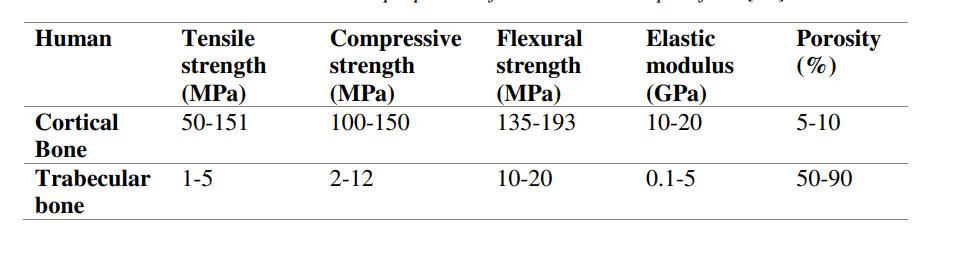
Mechanical properties of human bones
Ideally, the bone implant should be:
1. Bone conduction
2. Osteogenesis
3. Osteogenesis
4. Biocompatibility
5. Bioabsorbable
6. Not easy to get infected
7. Accessibility
8. Compatible with mechanical properties
9. Cost effective
Previous research has produced many different methods of producing scaffolds, whether these scaffolds are biocompatible, osteogenic or absorbable. Here, HAp slurry showed good behavior in storage (not more than 20 days) and then flow deposition, including viscous extrusion and photopolymerization.
Create complex structures with complete layer cohesion without supporting materials.Use 41% (volume) HAp slurry to3D printingScaffolding with different pore diameters of approximately 130 μm. SEM and fluid flow confirmed that the holes are connected to each other through the structure, resulting in these scaffolds that can be used for cell growth in orthopedic applications, thereby reducing the risk of fracture healing.The uneven distribution of densification can generate local stresses, which can lead to cracks in the implant.SureImplantsThe relationship between size and sintering retention time (T1) should be resolved in future work to obtain uniform densification and minimize cracks. In addition to the brittleness of HAp, the above problems also show lower flexural strength than its green body. Therefore, the research on the mechanism of avoiding the thermal gradient during the sintering process and the strengthening mechanism of HAp.
China3D printingNet original article!
(Editor in charge: admin)
0 Comments for “Researchers test 3D printed hydroxyapatite structure to study bone regeneration”