

China3D printingNet October 20th, 3D-printing and additive manufacturing processes are developing at lightning speed, but nuclear materials scientists at the U.S. Department of Energy (DOE) Argonne National Laboratory are concerned about this.They emphasize3D printingFor the importance of the nuclear industry, scientists continue to research new materials in depth-and use them to promote the recycling of very sensitive materials.
Before,ArgonScientists at the National Laboratory have been able to recycle up to 95% of spent fuel from nuclear reactors. However, the remaining 5% of the fuel still needs to be stored.But now all this is changing becauseArgonOf scientists are planning3D printingSome parts are recycled at a higher rate.
Scientists recently published the “Simplified Sub-Act Series Element Lanthanide Separation Process (ALSEP) and Additive Manufacturing to Close the Nuclear Fuel Cycle”, explaining how “how to use nuclear fission to expand low-carbon base load electricity production and the long-term nuclear fuel cycle? The life-span act is the element isotope.” In addition, they can reuse 2% of the nuclear material.Argonne (Argon) Nuclear chemist Andrew Breshears (Andrew Breshears) said: “This great application will save mankind from storing the remaining five percent of nuclear materials for hundreds of thousands of years, while the remaining three percent It needs to be stored for about a thousand years.” “In other words, this extra step can greatly reduce the storage time. Decomposing nuclear material in a fourth-generation fast reactor will generate more electricity. “
Scientists achieved their goal by separating a and cur from rare earth metals called lanthanides. With the help of additive manufacturing processes, they can overcome the ongoing challenges of scaling up test tube work to larger scales.When redesigning the process of separating chemical substances, researchers can3D printing“Contactors” and link them.Breshears said: “This bridges the gap between laboratory-scale and industrial-scale element separation.”The goal of the scientists is to use a 36-step separation blueprint to separate 99.9% of the elements from the lanthanides.
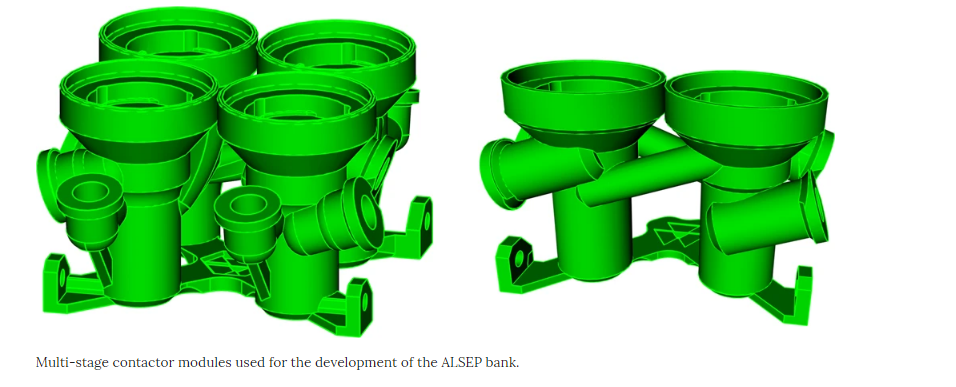
Use simplified sub-Act element lanthanide separation process (ALSEP) and additive manufacturing to shut down the nuclear fuel cycle
Breshears said: “Because their oxidation states are the same, it is difficult to separate.”The research team also found that when using3D printingWhen the contactor is a safety measure, the tube connecting the contactor can prevent di or radioactive material transfer.They also realize that they have3D printingHow useful the flexibility provided by the material is.If the part does fail, it is easy to reprint and replace it. We can easily add or delete steps.Breshears said: “Maybe we will find a new way to reduce the scale of the process.” The more the elements are separated, the more we can reduce their impact on the public and the environment. ”
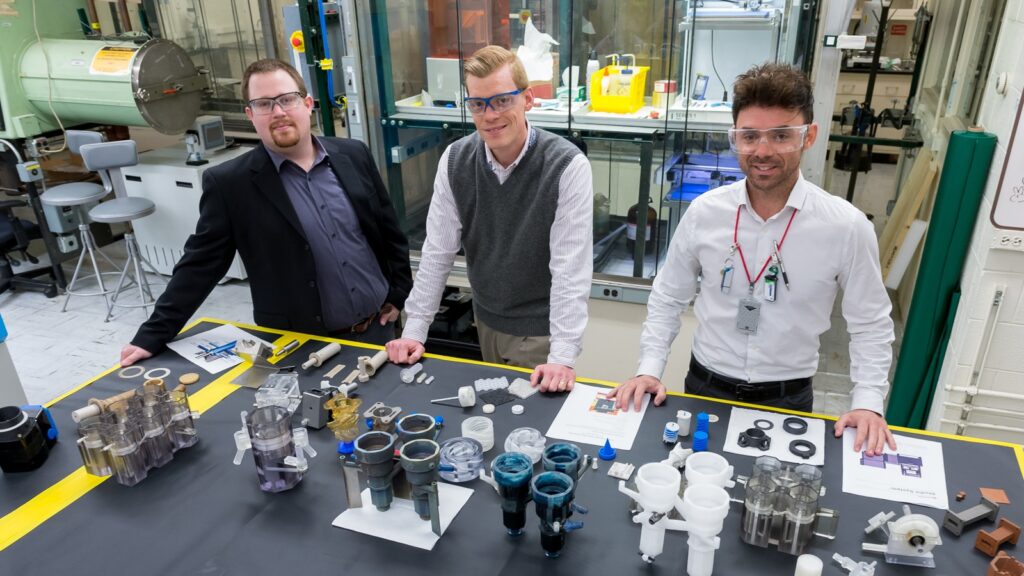
32783D, CFCT Chemist Group: Andrew Breshears, Peter Kozak, Alex Brown
According to China3D printingWang understands that this research was supported by the Office of Nuclear Energy of the U.S. Department of Energy.
China3D printingOnline reviews:3D printingAn innovation is constantly being produced almost every day.No one wants to accumulate more garbage on the earth, so many companies are committed to recycling, from turning used powder into filaments, using composite materials, and studying the comparison between original materials and recycled materials, etc. forThe Argonne laboratory is already in the forefront of nuclear waste processing in the world, and the application of this project technology will greatly reduce the risk of nuclear pollution..
China3D printingNet original article!
(Editor in charge: admin)
0 Comments for “U.S. Argonne National Laboratory: Recycling nuclear materials through 3D printing technology”